Blood and Marrow Transplant Options
Transplant options for every child
When we meet a child in need of a transplant, we search all available donor options. Doing so means we can quickly find the best solution for each child. As a transplant center for the National Marrow Donor Program, Children’s Mercy has access to donor registries throughout the world.
There are two types of transplants:
-
Allogeneic transplant is when cells are obtained from someone else.
-
Autologous transplant is when the patient’s own cells are used.
Types of donors include:
-
Matched siblings
-
Partially matched related donors (including parents and siblings), also called a haploidentical transplant
-
Unrelated donors from a volunteer registry
-
Umbilical cord blood units
We can obtain healthy cells from the donor in different ways. These include:
-
Bone marrow – typically taken from the back of the hip bones from the donor
-
Peripheral blood – taken from the blood of the donor by using a machine to filter out the stem cells
-
Cord blood transplants – using stem cells from donated umbilical cords
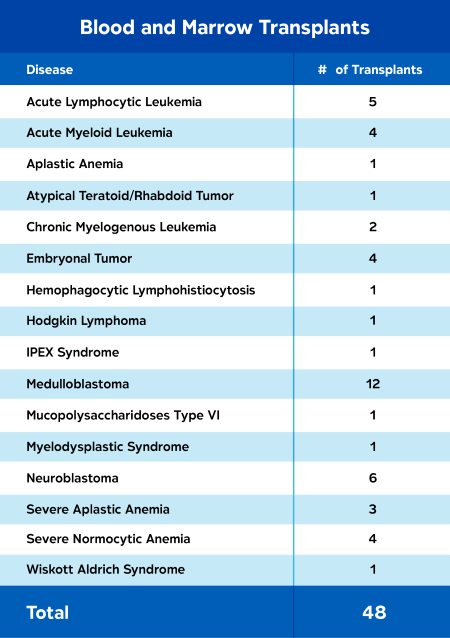
Transplants completed in 2024