
Tate's Story
Meet Tate

When Taylor and Caleb Jeter found out they were pregnant with their second baby, Tatum (Tate), they reached out to the medical team who cared for their firstborn, Reese. The Jeters had no initial cause for concern, but they knew what could happen better than most parents: Reese had been diagnosed with fetal heart block at 21 weeks.
The family moved home to Knob Noster, Mo., from Germany, where Caleb had been stationed at Ramstein Air Base. A multidisciplinary team at Children’s Mercy monitored the pregnancy, supported Taylor, delivered Reese, cared for her in the CICU, implanted her pacemaker and has been following her ever since.
Taylor and Caleb hoped they wouldn’t face the same challenges this time, but they felt better having Children’s Mercy in contact with their local clinicians.
When Taylor was pregnant with Reese, she didn’t know she had Sjogren’s disease. Along with other symptoms, the autoimmune disorder can cause pregnancy complications. Taylor began infusions to help protect Tate from her antibodies.
For a while, Tate's heart rate remained steady in the upper 150s. But at 21 weeks, it dropped to 58 beats per minute.
“When you’ve gone through it before, you know exactly what’s wrong,” said Taylor. “I knew he had complete heart block. I knew it was bad. I asked if we could transfer to Children’s Mercy.”
She wanted the familiar faces and fluidity of care at Children’s Mercy. It’s not common for families to return to the Elizabeth J. Ferrell Fetal Health Center, so when the Jeters appeared on the clinic schedule, some of her previous care team thought it was a system glitch. “No, it’s real!” Taylor told them.
“We greatly valued the profound trust she placed in our team to care for both her and her baby,” said Kelsey Brattrud, MSN, APRN, FNP-C, Ward Family Heart Center. “I was just blown away at Taylor and Caleb’s forethought coming into this pregnancy. They were very level-headed and able to keep perspective.”
Familiar faces, full-spectrum care
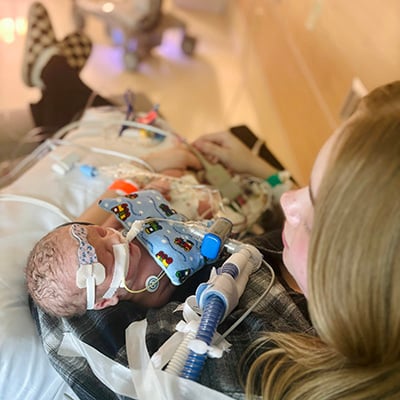
The family traveled to Children’s Mercy once a week, then twice a week, to meet with the Fetal Health Center, Neonatology and Heart Center’s multidisciplinary specialists — many of whom they already knew.
“We offer the full spectrum of care, technology and procedural/surgical expertise to ensure the best possible outcomes,” said Philip M. Chang, MD, FACC, FHRS, Director, Electrophysiology, who was on Reese’s team as well.
“With Reese, her heart rate stayed in the low 50s,” said Taylor. “With Tate, after our first few appointments at Children’s Mercy, his heart rate dropped to the 40s. We were on very thin ice with him.”
The family made small goals, hoping for one more week with him at a time. His care team did everything they could, including trying medicines that hadn’t worked for his big sister. Fortunately, Tate responded well, and his heart rate came back up into the 50s.
His team began talking about the safest timing for delivery.
“It was a multidisciplinary discussion with our Maternal-Fetal Medicine, Fetal, Neonatology, Electrophysiology and Cardiology teams,” said Jill Westcott, MD, Maternal-Fetal Medicine. “We want to get babies out before they’re really in distress, but they have to be big enough to be able to get a pacemaker.”
Taylor and Caleb specifically requested Reese’s cardiothoracic surgeon, William Douglas, MD, Heart Center, for Tate’s surgery. The team scheduled a C-section and pacemaker surgery in adjoining operating rooms — just like they did for Reese’s C-section and temporary pacemaker surgery. They anticipated outcomes and conducted in-OR walk-throughs, so roles and procedures were clear.
“It’s very hard to predict a baby’s condition before they’re born,” Stephanie Kukora, MD, Neonatology, whose role was resuscitation on delivery day. “We always prepare for the worst and plan to be ready to intervene as quickly as possible if it is needed.”
Delivery to surgery in minutes
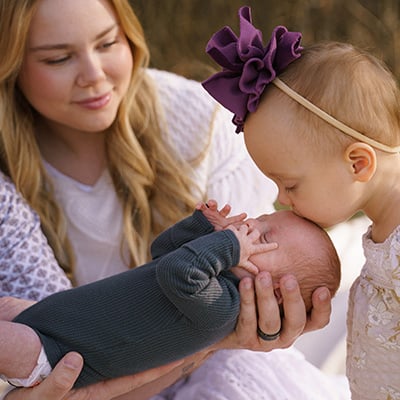
At 34 weeks, the timing was right for Tate’s delivery. A (very) large team was more than ready to welcome him.
“I was on vacation when Reese got delivered, so I made sure I was there to assist with Tate’s delivery!” said Dr. Westcott.
“Going into Reese’s C-section, I was in tears,” said Taylor. “It was scary, and we just didn’t know the odds at that point. With Tate, I was more confident: 'We got this. They’re going to handle it. Everything’s going to be fine.’”
This time, when Taylor was wheeled into the OR, she took a beat to look around and take everything in before Tate barreled into the world.
"He came out screaming,” laughed Dr. Westcott. “He did not appreciate the eviction notice.”
Taylor and Caleb had enough time to snap a picture and give him a kiss before Tate went into surgery. They went back to the Fetal Health Center, where Taylor could recover while they waited for news.
“It was very calming because I was with the same nurses who took care of me with Reese,” said Taylor. “I knew I could trust them. It was that same high level of care.”
Making his entrance at four pounds, Tate was big enough to get a micro-pacer right away.
“Fortunately, Tate was stable, like Reese was, and we were able to slowly and carefully get the lead placed on him,” said Dr. Douglas. “The biggest part of that was Tate. He just cooperated!”
The surgery went well, and Tate remained stable afterward, too. He was in the CICU for three or four days, then the NICU until early March — a little more than a month altogether.
“Tate was the decider of everything,” said Zalie Landes, BSN, RN, CPN, Fetal Cardiology Program Coordinator. “We just kept saying, ‘He’s going to be the one to tell us what he wants.’ And [we] were ready to follow what he needed.”
Home again ... again

The Jeters went home in early March, much more confidently this time.
“When you have a heart baby, taking them home for the first time is scary,” said Taylor. “You question everything. With Tate, we had already gone through it, and it was more peaceful. I know he’s ok.”
The Jeters can scan their kids’ pacemakers and send results to their care teams. They have their check-ups every 6 months on the same day.
“I continue to follow both Reese and Tate in my clinic and manage both of their pacemakers,” said Dr. Chang. “The Jeters are a wonderful family! I am truly privileged to be a part of their kids’ lives and to help with their care.”
Big sister Reese is turning 2 in August. She underwent an upgrade to a dual chamber pacemaker earlier this year and is doing well. She loves helping take care of Tate. “She’s like little mama 2.0,” said Taylor. She only has a few words so far, but one of them is “bubba,” for her little brother.
“She’s just a crazy little toddler now,” said Taylor. “She runs around and eats all the snacks. She’s a spitfire!”
The family is looking forward to a chill summer with lots of family time outside. Tate seems very happy to just hang out and hit the 12-pound mark recently. “He’s a great baby,” said Taylor. “He’s just such a calm, relaxed little man.”
He must get it from his parents. “[Taylor and Caleb are] so down to earth,” said Zalie. “They go with the flow, and it showed with Reese’s and Tate’s care.”
“It’s been a full family adventure for them for sure,” agreed Dr. Westcott. “They are very adaptable parents. They do what’s best for their kids, and it makes them really easy to work with.”
The gratitude goes both ways!
“Without these people, we wouldn’t have a family,” said Taylor. “We’re very thankful.”