
Making Needle Procedures More Comfortable for Children
The Comfort Promise from Children's Mercy
Our patients tell us that one of the things they worry about when coming to Children’s Mercy is getting a shot or poke. Health care procedures, especially when they involve a needle, can be scary for children, teens and adults!
When we give children ways to cope during needle procedures, it can help them:
- Have a sense of control.
- Be part of their own care.
- Cope with future health care events.
- Have a better overall experience.
We understand: Needles hurt. We want to make it better.
At Children’s Mercy, we have a plan called the Comfort Promise that will help make your child’s needle procedure easier. A needle procedure could include a blood draw, an immunization or placing an IV.
This is our Comfort Promise to you and your child:
- We will offer a special medicine to numb your child’s skin before the needle procedure.
- We will let your child sit up in a comfortable position with you supporting them.
- We will help your child be distracted during the poke with things like a book, game, video or happy thoughts.
- For babies, we will offer sugar water on a pacifier or for moms to breastfeed during the needle procedure.
We promise to do everything we can to eliminate pain – one poke at a time.
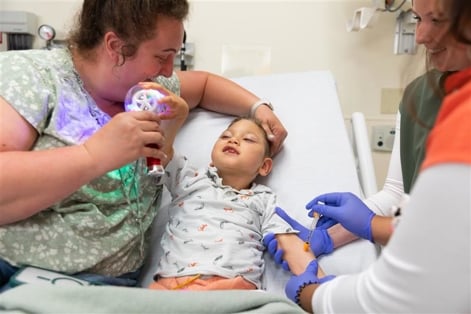
Overview of our Comfort Promise
Get more information about the Comfort Promise that you can download, save and print.
4% Lidocaine Cream
Learn how to apply topical lidocaine cream to numb your child's skin before a needle procedure.
The Comfort Promise by age
The Comfort Promise steps are always the same, but the way we use them may look different depending on your child’s age, the type of procedure and where it happens.
Your care team will work with you to make a plan for your child’s age, health history, needle procedure type and Children’s Mercy location.
Most importantly, we care about your child’s preferences and personality. You can look at each age group below and see how the Comfort Promise can work for your child.
- Numbing the skin: We have special medications we can put on your child’s skin to help them not feel the needle poke as much. Your care team will recommend which medication to use based on your child’s procedure, age, weight and the location on the body where it will take place.
- Cream
Read page 2 of our Comfort for Needle Procedures for instructions on using numbing cream.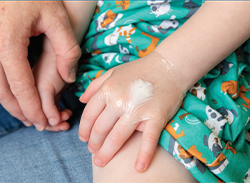
A child’s hand with lidocaine numbing cream - J-Tip
See an example of the J-Tip in action (video).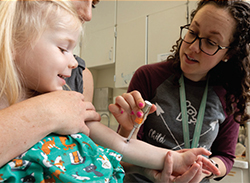
A J-Tip being used to apply numbing medication on a child's arm.
- Cream
- Comfort Positions: Swaddling and holding babies comforts them. We would like you, another caregiver or a staff member to hold your child in a secure and comforting position during the procedure. This lets them be comforted while also staying still and safe during their procedure. See our coping plan cards on the Building Your Own Comfort Kit page for ideas on comforting holds for your child.
- Distraction: You can help your baby stay calm by shifting their attention to something else. You can make eye contact with them and sing and coo. You can also use books, music, rattles or toys that make noise. For more ideas, check out this information on creating your own comfort kit.
Most Children’s Mercy locations and areas have items you can use for distraction.- If you are at the Adele Hall (Downtown) location, you can go to the Kreamer Resource Center for Families to check out a distraction kit before your clinic or lab appointment.
- Child life specialists can also help you with distraction, support and information. If you’d like their help during needle procedures or other medical events, please contact them in one of these ways:
- Call (816) 983-6870.
- If you are currently at the hospital, please ask a nurse or staff member to contact a child life specialist.
- Sucrose and breastfeeding:
-
- Sucrose (sugar water)
- Sucrose helps ease pain for babies who are newborn to 1.5 years old.
- Babies should get sucrose 2-3 minutes before a procedure and throughout the procedure.
- Sucrose can be given on a pacifier, in a syringe or on a finger.
- Breastfeeding
- When you breastfeed during a needle procedure, it helps your baby feel less pain.
- You should begin breastfeeding 2-5 minutes before the procedure and continue throughout the procedure.
- If your child unlatches, gently reposition and continue when your baby is ready.
- Sucrose (sugar water)
- Numbing the skin: We have medications we can put on your child’s skin to help them not feel the needle poke as much. Your child’s care team can recommend which medication will work best for your child.
- Cream
Read instructions on using numbing cream (page 2)
A child’s hand with lidocaine numbing cream - J-Tip
See an example of the J-Tip in action (video).
A J-Tip being used to apply numbing medication on a child's arm.
- Cream
- Comfort Positioning: Letting children sit up during a procedure comforts them and gives them a sense of control. You, another caregiver or a staff member can hold your child during the procedure. This lets them be comforted while helping them be still and safe during their procedure.
- Distraction: You can distract your child by helping them focus on something other than the procedure. Some ideas:
- Help your child look at books, rattles, toys, a phone or tablet.
- Play counting games or “I Spy.”
- Sing or listen to music.
- Help your child take deep breaths.
- You can do this by blowing bubbles, blowing on a pinwheel or pretending to smell flowers and blow out candles.
- If possible, practice with your child ahead of time.
Ask a Children’s Mercy staff member about other distraction options such as Buzzy®, Shot Blocker® and cold spray. For more ideas, check out this information on creating your own comfort kit.
Most Children’s Mercy locations and areas have items you can use for distraction.
- If you are at the Adele Hall Campus (downtown), you can go to the Kreamer Resource Center for Families to check out a distraction kit before your clinic or lab appointment.
- Child life specialists can also help you with distraction, support and information. If you’d like their help during needle procedures or other medical events, please contact them in one of these ways:
- Call (816) 983-6870.
- If you are currently at the hospital, please ask a nurse or staff member to contact a child life specialist.
- Numbing the skin: We have medications we can put on your child’s skin to help them not feel the needle poke as much. Your child’s care team can recommend which medication will work best for your child.
- Cream
Read instructions on using numbing cream (page2)
A child’s hand with lidocaine numbing cream - J-Tip: A J-Tip being used to apply numbing medication on a child's arm.
See an example of the J-Tip in action (video).
A J-Tip being used to apply numbing medication on a child's arm.
- Cream
- Comfort Positioning: Letting children sit up during a procedure comforts them and gives them a sense of control. You, another caregiver or a staff member can hold your child during the procedure. This lets them be comforted while helping them be still and safe during their procedure.
- Distraction: Children this age can choose if they want to know when the needle poke is coming. Some prefer not to know and just focus on a distraction instead.
You can distract your child by helping them focus on something other than the procedure. Some ideas:
- Help your child look at books, rattles, toys, a phone or tablet.
- Play counting games or “I Spy.”
- Sing or listen to music.
- Help your child take deep breaths.
- You can do this by blowing bubbles, blowing on a pinwheel or pretending to smell flowers and blow out candles.
- As children get older, they can practice other ways to breathe slowly and deeply, like outlining a box on paper with their finger as they breathe in to a count of 4 and out to a count of 4.
- If possible, practice with your child ahead of time.
Ask a Children’s Mercy staff member about other distraction options such as Buzzy®, Shot Blocker® and cold spray. For more ideas, check out this information on creating your own comfort kit.
Most Children’s Mercy locations and areas have items you can use for distraction.
- If you are at the Adele Hall Campus (downtown), you can go to the Kreamer Resource Center for Families to check out a distraction kit before your clinic or lab appointment.
- Child life specialists can also help you with distraction, support and information. If you’d like their help during needle procedures or other medical events, please contact them in one of these ways:
- Call (816) 983-6870.
- If you are currently at the hospital, please ask a nurse or staff member to contact a child life specialist.
- Numbing the skin: We have medications we can put on your skin to help you not feel the needle poke as much. Your care team can recommend which medication will work best for you.
- Cream
Read page 2 of our Comfort for Needle Procedures for instructions on using numbing cream.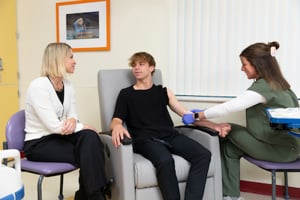
A teen's arm with lidocaine numbing cream. - J-Tip
See an example of the J-Tip in action (video).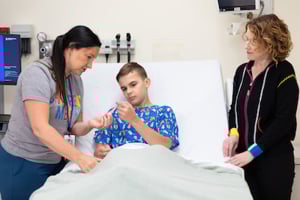
A J-Tip being used to apply numbing medication.
- Cream
- Comfort Positioning: Letting teens sit up, and in a spot they choose, helps comfort them and give them a sense of control. We want teens to tell us what position feels best and what role, if any, they want parents to play during the procedure.
- Distraction: Teens can stay focused and calm during a procedure by using distraction.
Teens may want to talk with their parents or medical team ahead of time about what helps them feel more comfortable — whether that’s having someone explain what’s happening during the procedure or staying focused on a distraction instead.
Popular distraction choices for teens:
- Listening to music or a podcast.
- Using a phone or handheld game.
- Watching a video or playlist.
If a parent or sibling is there, they can help by:
Deep breathing can help the body relax and make medical procedures feel easier. To try it, breathe in slowly for a count of 4, then out for a count of 6.
- Talking about something exciting coming up.
- Telling jokes.
- Playing word games.
Most Children’s Mercy locations and areas have items you can use for distraction.
- There are free or low-cost apps and videos — like Breathe2Relax, Calm, EZ-Air Plus, or YouTube relaxation videos — that can help guide breathing.
- It’s a good idea to practice deep breathing before the procedure.
- If you are at the Adele Hall Campus (downtown), you can go to the Kreamer Resource Center for Families to check out a distraction kit before your clinic or lab appointment.
- Child life specialists can also help you with distraction, support and information. If you’d like their help during needle procedures or other medical events, please contact them in one of these ways:
- Call (816) 983-6870.
- If you are currently at the hospital, please ask a nurse or staff member to contact a child life specialist.
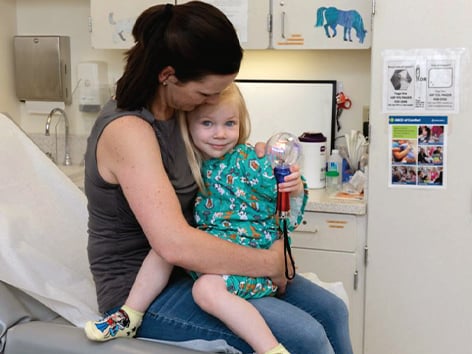
Build a comfort kit
You can help your child prepare for a needle procedure by building a comfort kit before their medical visit.
Adaptive care plans
If your child’s needs are more complex (if they have a needle phobia or sensory issues, for example), talk to your provider or contact Child Life about completing a My Needle Procedure Plan.
Learn more about adaptive care plans
Our care teams are committed to making your child's experience as comfortable as possible, including our child life specialists.
Learn how child life specialists can help
Comfort Promise: Anna's story
Anna had such severe needle phobia, it interfered with receiving vaccinations and having important lab tests done. Now thanks to our Comfort Promise, Anna is no longer afraid!

Comfort Promise: Mercy's story
Mercy had a lot of anxiety surrounding needle procedures, and negative experiences reinforced past trauma. With the Comfort Promise, Mercy now has a plan in place that helps these procedures go smoothly.
More resources
Here are more resources that can help make needle procedures more comfortable:
Patient and Family Seal of Collaboration
This material has earned the Patient and Family Seal of Collaboration. It was developed in partnership with patients, families and Children's Mercy team members to improve the health care experience.
Learn more about the program and share your ideas with us.