
Type 1 Diabetes: Logan’s story
Meet Logan
For the past 2 years, 12-year-old Logan and his dad, Lance, have packed some extra gear for their annual hiking trips. They leave space in the lids of their 30-pound packs for the equipment that keeps Logan’s blood sugar levels stable.
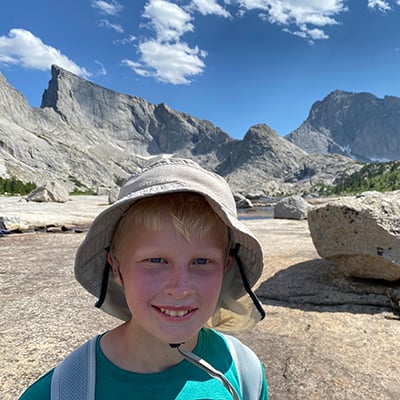
“Before we go on our trip, I make sure I know how many days we’re going, how many Dexcoms (biosensors), pumps and pens I need,” said Logan, who was diagnosed with type 1 diabetes when he was 10.
“And then we add one extra,” said Lance. “In case the electronics fail, we also take an insulin pen with needles and a glucometer.
We’ve never needed those things so far!”
The few added ounces haven’t slowed Logan down. This summer, he hiked 8.5 miles to a remote lake for four days of off-grid camping ... and no diabetes complications. That’s exactly what his care team at Children’s Mercy loves to hear.
“We want you to be confident and independent — that’s our goal when we treat you,” said Fadi Al Muhaisen, MD, MBA, FAAP, Medical Director, Wichita Endocrine Clinics.
Sneaky symptoms and a fast flight
Dr. Fadi (as his patients call him) first met Logan in February 2023. His team provided diabetes services for Logan after he was flown to a local hospital in Wichita, Kan., from a Garden City, Kan., emergency room. (Children’s Mercy Wichita has strong partnerships with community hospitals in the area.)
“He was in severe DKA (diabetic ketoacidosis),” said Dr. Fadi. “He had all the symptoms: the weight loss, the high blood sugar. He was treated for DKA, and then we diagnosed him with type 1 diabetes.”
Logan’s symptoms initially seemed to be a slow-moving winter flu. The Saturday before, he had been the lead scorer for his tournament-winning basketball team. But by the end of that next week, he felt terrible.
“The day before I went to the hospital, I couldn’t really even move,” remembered Logan. “I just stayed on the couch.” His grandmother was the one who suspected he might have diabetes. He had been much thirstier than normal that week, which can be a symptom of DKA.
His sickness came in the middle of a hard season for his family. Logan’s mom, Amber, was battling cancer at the time and had just had surgery. It was a lot to handle all at once. “I feel horrible we didn’t catch it earlier; we really just thought he had a bug,” said Amber.
From “what’s a pancreas?” to thriving with type 1
Their local ER tested his sky-high glucose levels and transferred him to Children’s Mercy right away. Logan doesn’t recall much from that night, except for falling asleep on the plane and being woken up for blood-sugar checks. His new care team at Children’s Mercy got him stabilized.

The next morning, Logan and his parents began learning how to live with type 1 diabetes, also called insulin-dependent or juvenile diabetes. Logan’s body wasn’t making enough insulin to control his blood sugar levels, so he would need to learn how to monitor them himself.
“Dr. Fadi said my pancreas wasn’t working, and I’m like, ‘I don’t even know what a pancreas is!’” Logan laughed, but he was a
quick learner, and Dr. Fadi is a great teacher. He explained what insulin does and how Logan would need to give himself insulin now. “By the third day, I understood everything; he explained it to me,” said Logan.
“I remember how kind and encouraging the nurses and doctors were from the very beginning,” said Lance. “They asked Logan what his interests were and reassured him that he would continue to be able to do those things.”
At first, Logan was a little scared to give himself insulin with an insulin pen, which delivers a dose through a small needle. But he mastered the skill with some practice. After several days of recovery and diabetes education in-hospital, Logan said he felt “awesome” and was ready to go home. His diabetes team would only be a phone call away.
“We typically ask our families to call us on a daily basis right after a diabetes diagnosis,” said Dr. Fadi, who shared that as families gain confidence, they need to call less frequently. Logan has most of his Children’s Mercy care through telehealth now, to save them the drive.
Tech that keeps diabetes in the background
In addition to his Children’s Mercy team, Logan also had some very cool tech to support him. Fairly early on, he was able to start using a Dexcom (a continuous glucose monitoring system) and an insulin pump.
“I have an app on my phone now, and I can put in how many carbs I'm eating,” explained Logan. "The Dexcom connects to it and gives blood sugar readings, and it decides how much insulin it needs to give me through the pump. So it's really easy to do.”
Logan can eat what he wants, as long as he’s monitoring, tracking and getting the right amount of insulin. He wears the monitor on his arm. It takes about 30 minutes to warm up, and then it begins delivering blood sugar readings every 5 minutes to guide the pump’s output.
“I want the pump and Dexcom to be the standard of care for everyone, because it's incredible,” said Amber.
For the system to work, Logan has to be near his phone, but the distances have been increasing with new upgrades. “I can be 30 feet away, so in school, I can go do activities without having to have my phone in my pocket,” said Logan. This is important to a basketball and tennis player who loves to move!
“We don’t want them to be defined by their diabetes or feel like they are trapped in that diagnosis,” said Dr. Fadi. “That’s why we try to empower them with not just excellent care but the highest technology available for their age.”
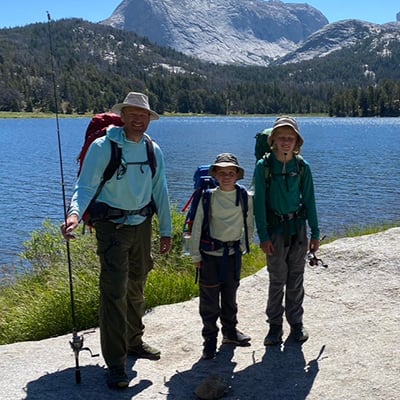
"It doesn’t need to slow you down!”
Amber and Lance want other parents to know they can adjust to a type 1 diabetes diagnosis, too.
“You’re not alone,” said Amber, who raved how quickly their care team answers questions and concerns. “If you’re with the right doctor and nurses, you have a team. I wish everyone who has type 1 diabetes has a Dr. Fadi and all of the nurses in Wichita. They are the kindest people.”
Lance recently got to encourage a co-worker whose child was just diagnosed: “I could tell her that the first weeks, especially, are overwhelming, and the first couple months are hard. But it will all be okay: You will get this!”
“We don’t want you to just live with diabetes; we want you to thrive,” said Dr. Fadi. “I always tell my patients the sky is the limit.”
Logan and his hiking trips are proof. “It’s going to be okay,” he says to other kids learning to thrive with diabetes. “It doesn’t need to slow you down — it doesn’t slow me down!”