Get updates
Have a parenting hack to share? Or a topic you'd like to see?
Child therapy insights: What happens in a session

Contributing Authors
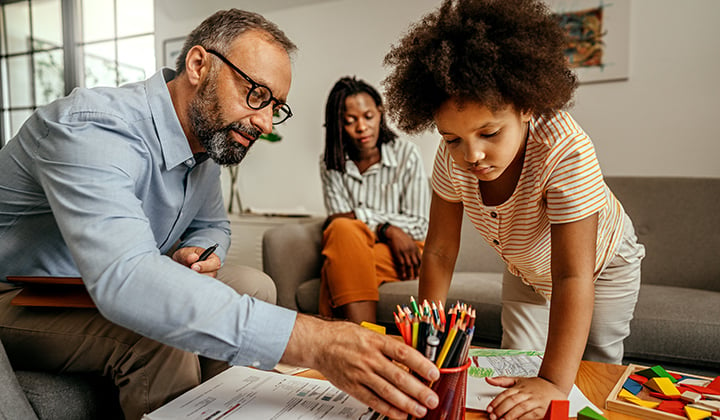
Therapy can feel like a big step for families. Even when you know your kid could use extra support, it is normal to feel unsure about child therapy. What really happens in a therapy session? Will your kid talk? Will it feel uncomfortable? Will someone tell you that you have been doing everything wrong?
Keep reading to learn what actually happens during a therapy session with kids and why therapy for kids often feels calmer and more supportive than parents expect. Understanding how child therapy works can make it easier to take that first step, especially if you are searching for a “child psychologist near me” or wondering whether child counseling is the right fit.
Prefer to listen? Check out this episode of the Parent‑ish podcast. Click the link or listen wherever you get your podcasts to hear a child psychologist explain what child therapy and child counseling look like in real life.
Therapy for kids looks different than therapy for adults
Kids do not experience therapy the same way adults do. Sessions usually do not include long talks or big emotional questions. In child therapy, the focus is on meeting kids where they are and using developmentally appropriate tools.
Instead, therapy for kids often includes play, games, drawing or movement. These tools help kids share feelings when they do not yet have the words, most of us are not born knowing how to talk about our feelings. Play helps kids learn skills, handle emotions and feel safe. This is a core part of child counseling and is often what makes child therapy so effective for younger children. Just to be clear, not all play during therapy is “play therapy” and typically, play can be helpful during therapy sessions to build comfort in talking to someone new.
It may look simple, but there is a lot of purpose behind it. A trained child psychologist or another child therapist uses play and activities intentionally to understand what a child is going through and to teach coping strategies in a way that feels natural.
What therapists are really watching for
Therapists are not looking for perfect behavior or quick answers during child therapy. They pay attention to patterns over time, especially in therapy for kids who may express themselves more through actions than words.
They notice how a kid reacts to stress, how they handle frustration, and what helps them feel calm. Every response to what happens in the therapy room gives helpful clues. This allows child counseling to support the kid in a way that fits them, not a checklist. The goal of therapy for kids is to build skills, confidence and emotional safety, rather than to “fix” a child.
What if my kid does not want to talk?
This is a common worry, and the answer is reassuring. In child therapy, kids are not expected to open up right away. Trust takes time, especially in therapy for kids who may already feel overwhelmed or unsure.
Therapists move at a pace that feels safe for each child. Sometimes progress in child counseling looks like showing up, getting comfortable and slowly building trust through play and routine. That still counts as progress in child therapy, even if your child is not talking much yet.
Where parents fit into therapy
Therapy is not about blame. Parents are part of the process and often receive guidance or tools to practice and use at home. In many models of child counseling, the therapist will check in with parents regularly during sessions, share observations and offer strategies that support therapy for kids between sessions.
The goal is to support the whole family and help everyone feel more confident. You are not expected to be perfect, but we always hope that you will be present. A child psychologist or another child therapist will see you as a partner, not as the problem. You will almost always be asked to try a different strategy or approach with your child at home, not because you are doing something wrong, just to see if a shift in how you respond might help your child in the long-term.
What we hope you remember
Choosing therapy for your child does not mean something is wrong with your child. It means you are paying attention and asking for support. Reaching out for child therapy or child counseling is a sign of care, not failure. If you go to a therapy visit for the first time and your child does not display any behaviors that you are talking about, don’t worry, the therapist will believe that the behaviors are occurring when more demands are placed on them, such as being at home. It is very common for children to show up as the best version of themselves when they come to meet someone new.
Parenting is hard and no one is meant to do it alone. Therapy for kids can be one more tool to help your child and your family feel steadier. If you are thinking, “I really think they could benefit from talking to someone,” or wondering whether child counseling could help, know that taking that step is a meaningful way to support your child’s wellbeing now and in the future.
Contributing Authors
Get updates
Have a parenting hack to share? Or a topic you'd like to see?
Related Posts
- Hitting and biting: what parents need to know
- Debunking myths about COVID-19
- How to promote diversity and inclusion in your child’s life
- What every parent should know about preventing child trafficking
- The No. 1 rule about cleaning out earwax
- Food allergies: are more kids allergic to food or are we just more aware?
- Bedwetting: What causes it and when to be concerned?
- The great cover-up
- All about strep throat
- A parent’s guide to discussing white privilege