
Vaccine Update: Shingles Vaccine May Reduce the Risk of Dementia and Slow Disease Progression
Ongoing research suggests that the shingles vaccine can not only reduce the risk of dementia, heart disease and death in people age 50 and older but also slow the progression of dementia. Dementia refers to a decline in a person’s mental functioning, including thinking, memory, mood and behavior. It is not a specific disease, rather a set of symptoms that result from damage to the brain cells involved with cognitive function. The damage usually comes from a neurodegenerative disease, most commonly Alzheimer’s disease, although many conditions can lead to dementia. While people over the age of 65 are the ones usually affected by dementia, it isn’t a normal part of aging. The decline impacts a person’s ability to carry out activities of daily living and shortens their life expectancy.1
Shingles is caused by the reactivation of the varicella-zoster virus (VZV), which causes chickenpox infection. After staying dormant in the nervous system, VZV can re-emerge years later, causing shingles. Shingles is a painful blistering rash that develops along nerve paths and can also cause fever, headache, fatigue and sensitivity to light. In the United States, 1 in 3 adults will develop shingles.2 Reactivation of the virus is usually seen after age 50. Having the ability to lower the risk of dementia and cardiovascular events through shingles vaccination, which is more than 90% effective in preventing illness, would have significant positive outcomes for public health.
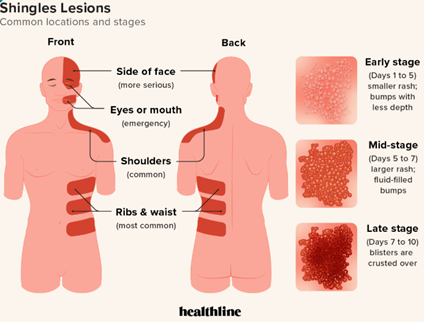
Source: Healthline- Everything You Need to Know About Shingles Lesions
Research data from a study conducted in Wales and published in April 2025 showed that older adults vaccinated against shingles weren’t just protected against the virus, but also had a 20% reduction in developing dementia over seven years.3 Additional research from Australia that was published in April 2025 also found that individuals who received the shingles vaccine had a significantly reduced risk of a new dementia diagnosis.4
In October, Case Western University presented research at IDWeek 2025 indicating that vaccination against herpes zoster (shingles) could reduce the risk of heart disease, dementia and death in adults aged 50 years and older. The researchers had conducted a matched cohort study that evaluated the health records of 174,000 patients at 107 U.S. health systems. They followed patients at three months to seven years post vaccination. Vaccination against shingles cut participants’ risk of vascular dementia in half and reduced their likelihood of serious cardiovascular problems—such as blood clots, heart attacks or strokes—by about 25%.5
In December 2025, research published in Cell suggested that live-attenuated shingles vaccination prevented or delayed mild cognitive impairment and dementia and slowed the disease progression of those who already had dementia. In this study, researchers also looked at age-eligible individuals compared to those who were just outside of age-eligibility for shingles vaccinations. This setup created two groups that were nearly identical except for a small difference in age.6
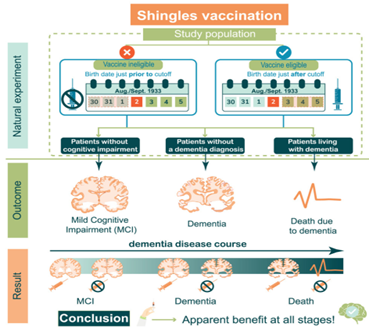
Source: Cell- The effect of shingles vaccination at different stages of the dementia disease course
While the evidence is promising, additional research still needs to be conducted. The current research evaluated people who received the Zostavax vaccine, which was a live-attenuated virus vaccine. In the United States, we now use Shingrix, a recombinant protein subunit vaccine. It is not yet clear whether suppression of the virus, mechanism of action of the vaccine or another unknown vaccine factor are what helps decrease the risk of dementia and heart disease. In the United States, the shingles vaccine is recommended for adults age 50 and older. Offering this not only as a vaccine but also as a way to slow or prevent dementia, cardiovascular disease and death could have a positive impact in the lives of many adults as they age.
References:
- Cleveland Clinic. Last reviewed December 5, 2025. Accessed December 22, 2025. https://my.clevelandclinic.org/health/diseases/9170-dementia
- What usually triggers shingles? Detroit Medical Center. Accessed December 22, 2025. https://www.dmc.org/healthy-living/corporate-content/what-usually-triggers-shingles
- Eyting M, Xie M, Michalik F, Heß S, Chung S, Geldsetzer P. A natural experiment on the effect of herpes zoster vaccination on dementia. Nature. 2025:641:438-446. doi:10.1038/s41586-025-08800-x
- Pomirchy M, Bommer C, Pradella F, Michalik F, Peters R, Geldsetzer P. Herpes zoster vaccination and dementia occurrence. JAMA. 2025;333(23):2083-2092. doi:10.1001/jama.2025.5013
- Van Beusekom M. Shingles vaccine tied to significant reductions in risk of dementia, heart disease, and death. CIDRAP. October 20, 2025. Accessed December 22, 2025. https://www.cidrap.umn.edu/adult-non-flu-vaccines/shingles-vaccine-tied-significant-reductions-risk-dementia-heart-disease-and
- Xie M, Eyting M, Bommer C, Ahmed H, Geldsetzer P. The effect of shingles vaccination at different stages of the dementia disease course. Cell. 2025;188(25):7049-7064.e20. doi:10.1016/j.cell.2025.11.007
Chief Wellbeing Officer; Professor of Pediatrics, University of Missouri-Kansas City School of Medicine; Clinical Assistant Professor of Pediatrics, University of Kansas School of Medicine