
Visual Diagnosis: An Acute Papular Eruption
Case Presentation
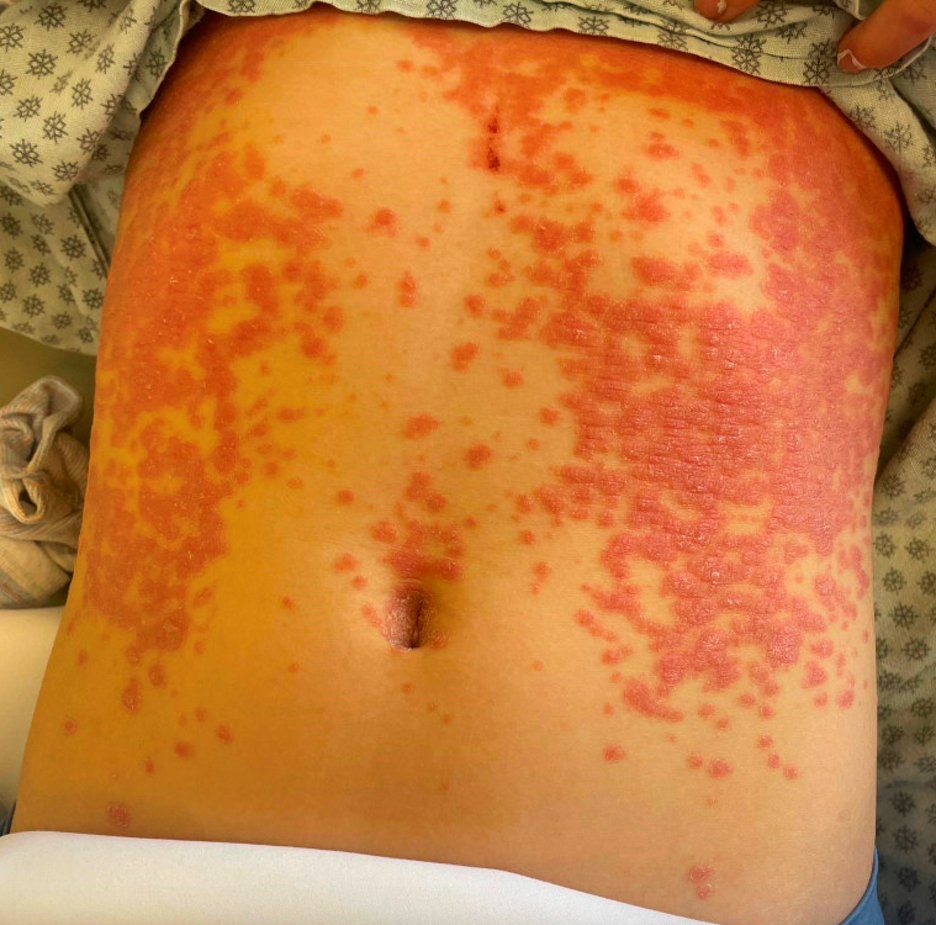
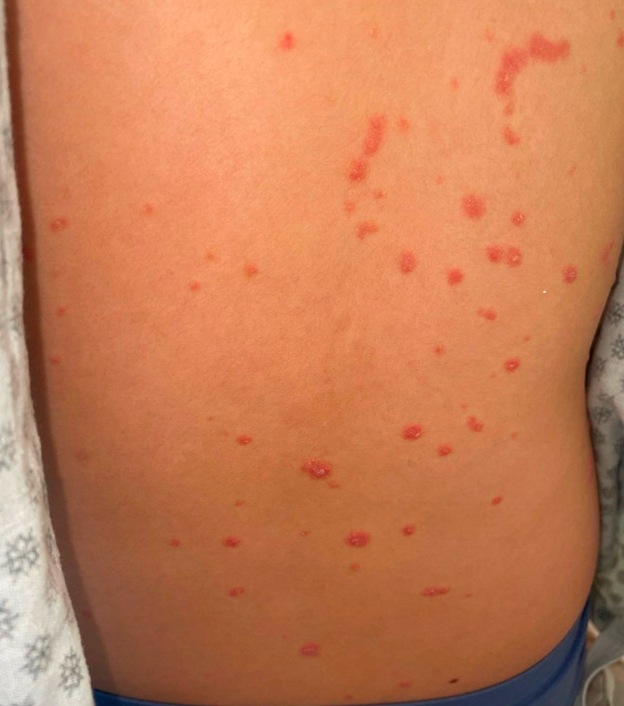
A previously healthy 10-year-old girl presented with a three-week history of a progressively spreading rash. Her parents first noticed several small “chicken pox–like” bumps on her chest, abdomen and buttocks four weeks prior. Since onset, the lesions have become more numerous and spread to her neck, face, back, arms, legs, hands and feet. The individual bumps have persisted, with some increasing in size, and the eruption has become more confluent in areas.
The child describes mild pruritus. She was evaluated by her pediatrician who thought she had pityriasis rosea and was prescribed hydrocortisone 2.5% ointment once daily for the past two weeks, which has provided partial relief of itch but no visible improvement in the rash. She also takes oral hydroxyzine at night, which helps with sleep and itch.
Around the time the rash began, she experienced a sore throat that resolved spontaneously. She denies fever, malaise, joint pain, stiffness or myalgias. There has been no blistering, bleeding, ulceration or oozing. She has not started any new medications and has had no recent travel, exposures or vaccinations.
She is otherwise healthy. She lives with her parents and siblings. There is no family history of psoriasis or other chronic skin conditions.
A throat culture obtained in clinic grew group A Streptococcus (GAS).
Her skin examination was notable for the findings shown in the photos below:
Question 1
What is the most likely diagnosis?
A. Guttate psoriasis
B. Pityriasis rosea
C. Viral exanthem
D. Secondary syphilis
E. Nummular eczema
Correct Answer: A. Guttate psoriasis
Explanation
This presentation is classic for guttate psoriasis, which typically consists of an abrupt eruption of numerous small, drop-like, pink scaly papules over the trunk and extremities. A preceding streptococcal infection is common and usually occurs one to three weeks before the rash.
The morphology and distribution also help distinguish guttate psoriasis from its common mimickers. Guttate lesions tend to have thin micaceous scale and appear suddenly in large numbers. Pityriasis rosea (PR) generally begins with a herald patch and follows a “Christmas tree” pattern on the trunk, meaning the lesions are distributed along the relaxed skin tension lines. PR typically presents with a collarette of scale rather than micaceous scale. Viral exanthems are often morbilliform, blanchable and short-lived and rarely persist for weeks without evolving. Secondary syphilis is uncommon in children and typically involves systemic symptoms and palmoplantar lesions. Nummular eczema produces coin-shaped, larger plaques that are often crusted or oozing rather than uniformly thin and scaly.
Given the lesion morphology, distribution, chronicity and preceding pharyngitis, guttate psoriasis is the most likely diagnosis.
Question 2
Which of the following is true regarding psoriasis-associated nail disease and the risk of psoriatic arthritis?
A. Nail pitting, onycholysis and oil-drop discoloration in children with psoriasis indicate increased risk of psoriatic arthritis.
B. Nail findings are purely cosmetic and not associated with systemic disease.
C. Psoriatic arthritis does not occur in pediatric patients.
D. Nail psoriasis occurs only in patients with severe plaque psoriasis, not guttate psoriasis.
Correct Answer: A
Explanation
Nail involvement in children with psoriasis is clinically meaningful. Changes such as pitting, onycholysis, oil-drop discoloration and subungual hyperkeratosis are frequently associated with a higher likelihood of developing psoriatic arthritis in the future. This association has been shown across age groups and is one of the strongest predictors of joint disease.
Psoriatic arthritis does occur in pediatric patients, sometimes years after the onset of skin disease. Children may present with joint stiffness, swelling or dactylitis. Identifying nail findings early is therefore important to guide anticipatory guidance and screening and to consider escalation to systemic therapy if needed.
Nail psoriasis can occur with any psoriasis subtype, including guttate psoriasis. It is not limited to chronic plaque disease. Psoriasis can also be isolated to the nails in the absence of other cutaneous involvement.
Question 3
What is the most appropriate initial management for this child’s guttate psoriasis?
A. Continue hydrocortisone 2.5% and observe.
B. Initiate medium- to high-potency topical corticosteroids; consider narrowband UVB phototherapy.
C. Begin systemic biologic therapy as first-line treatment.
D. Use an oral corticosteroid taper.
E. Initiate topical antifungals.
Correct Answer: B
Explanation
Initial treatment of guttate psoriasis depends on severity and extent. For most children, especially those with widespread papules but no systemic symptoms, medium- to high-potency topical corticosteroids (such as triamcinolone 0.1% ointment for the body and hydrocortisone or desonide for the face and folds) are appropriate first-line therapy. These agents reduce inflammation, scaling and pruritus and are safe when used correctly.
Because guttate psoriasis can be extensive and difficult to treat with topicals alone, narrowband UVB phototherapy is a well-established second-line or adjunct option. It is safe in children and particularly effective for guttate eruptions that follow streptococcal infection. Many children improve dramatically with a short course of phototherapy.
Hydrocortisone 2.5% may lack the potency to treat thicker psoriasiform papules and plaques, explaining the lack of improvement in this case. Systemic corticosteroids are avoided because of the risk of rebound or pustular psoriasis after tapering. Antifungals have no role unless dermatophyte infection is confirmed.
Biologic agents are not first-line for guttate psoriasis but may be considered for chronic, severe or recurrent disease, especially if psoriatic arthritis develops or if the disease evolves into chronic plaque psoriasis. The medications approved for pediatric psoriasis have expanded significantly in recent years. Biologic therapies approved by the Food and Drug Administration include anti-TNF agents such as etanercept, approved for children 4 years and older; IL-12/23 inhibitors such as ustekinumab, approved for children 6 years and older; IL-17 inhibitors such as secukinumab and ixekizumab, both approved for children 6 years and older; and IL-23 inhibitors such as guselkumab, also approved for children 6 years and older. Biologics target cytokines involved in the psoriatic pathway and are effective for moderate-to-severe psoriasis.
References
-
Griffiths CEM, Armstrong AW, Gudjonsson JE, Barker JNWN. Psoriasis. Lancet. 2021;397(10281):1301-1315. doi:10.1016/S0140-6736(20)32549-6
-
Menter A, Cordoro KM, Davis DMR, et al. Joint American Academy of Dermatology-National Psoriasis Foundation guidelines of care for the management and treatment of psoriasis in pediatric patients. J Am Acad Dermatol. 2020;82(1):161-201. doi:10.1016/j.jaad.2019.08.049
-
Hebert AA, Browning J, Kwong PC, et al. Diagnosis and management of pediatric psoriasis: an overview for pediatricians. J Drugs Dermatol. 2023;22(8):742-753. doi:10.36849/jdd.7531
-
Relvas M, Torres T. Pediatric psoriasis. Am J Clin Dermatol. 2017;18(6):797-811. doi:10.1007/s40257-017-0294-9
-
Kravvas G, Gholam K. Use of topical therapies for pediatric psoriasis: a systematic review. Pediatr Dermatol. 2018;35(3):296-302. doi:10.1111/pde.13422
Associate Program Director, Pediatric Dermatology Fellowship; Assistant Professor of Pediatrics, University of Missouri-Kansas City School of Medicine; Clinical Assistant Professor of Internal Medicine, University of Kansas School of Medicine