
Vaccine Update: Tick Bites Are at All-Time Highs—A Lyme Disease Vaccine Shows Promising Results
Spring is here, and many of us are once again enjoying longer walks, outdoor activities and time in nature. However, along with warmer weather comes a growing concern for many people: ticks. This concern is well-founded. This year, the incidence of tick bites has reached unusually high levels across the United States.
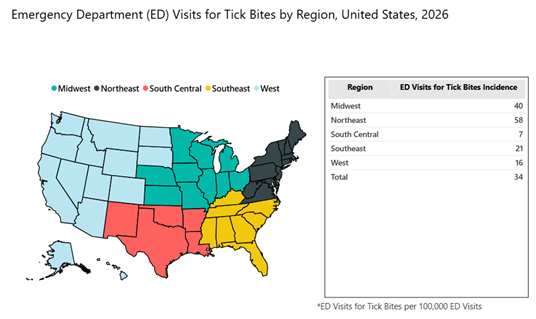
Emergency department visits for tick bites are currently three times higher than expected for this time of year. Most cases are being reported in the Northeast, with the Midwest experiencing the second-highest number of emergency department visits related to tick bites.1 Increased outdoor exposure combined with expanding tick habitats has intensified concerns about tick-borne illnesses, particularly Lyme disease.
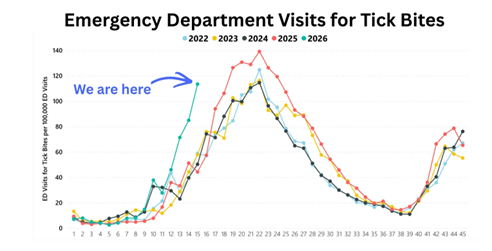
Data from CDC; Annotated by Your Local Epidemiologist.
Data from CDC Tick Bite Data Tracker
Lyme disease remains the most common vector-borne disease in the United States, with most cases occurring in the northeastern and north-central regions. Over the years, Lyme disease incidence has steadily increased. In January 2022, changes to national Lyme disease surveillance and reporting practices led to more accurate case identification. As a result, reported case counts rose significantly.2 The most recent national surveillance data from 2023 shows 89,468 cases reported to the Centers for Disease Control and Prevention (CDC) by state health departments and the District of Columbia. Using additional surveillance methods, public health experts estimate that approximately 476,000 people are diagnosed and treated for Lyme disease each year in the United States.3 Despite these national increases, Kansas and Missouri continue to be categorized by the CDC as low‑incidence states, with substantially fewer reported cases compared with high‑incidence regions.
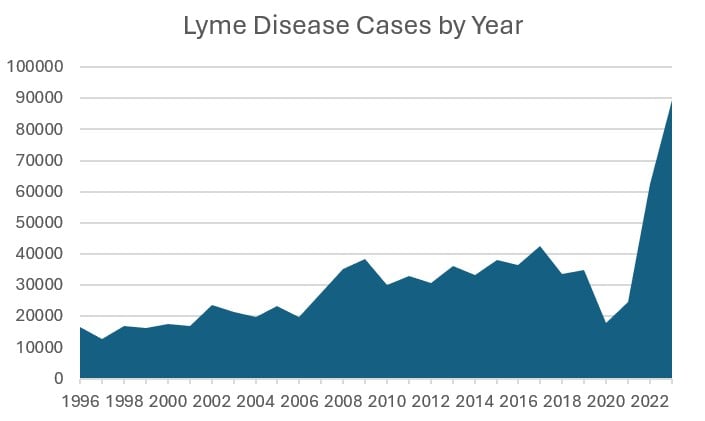
Data from CDC Lyme Disease Surveillance Data
Against this backdrop of increasing tick activity and rising disease burden, recent clinical trial results offer encouraging news. A new six-strain Lyme disease vaccine demonstrated approximately 70%–73% efficacy in preventing Lyme disease among individuals aged 5 years and older after completion of a four-dose series. The trials were conducted in high-incidence regions across the United States, Canada and Europe. Developed by Pfizer and Valneva, the vaccine has been reported to have a “clinically meaningful” ability to significantly reduce infections. The companies have announced plans to submit the vaccine for regulatory approval. If approved, it would be the first Lyme disease vaccine available in the United States in more than 20 years.4 The last Lyme disease vaccine approved in the U.S., LYMErix, was available from 1998 to 2002. Despite demonstrated effectiveness and safety, it was voluntarily withdrawn due to low public demand, intense media scrutiny over side effects, and litigation.5
The new Lyme disease vaccine uses a protein subunit that targets the outer surface protein A (OspA) of Borrelia burgdorferi, the bacterium that causes Lyme disease. It is designed to protect against the six most common OspA variants found in Lyme-causing bacteria across North America and Europe. This vaccine works inside the tick. When a vaccinated person is bitten, antibodies produced by their immune system are ingested by the tick during its blood meal. These antibodies bind to OspA within the tick, preventing the bacteria from leaving the tick and being transmitted to the human host. By stopping transmission before infection can occur, the vaccine provides a highly effective form of protection.4
As tick activity continues to rise and Lyme disease cases increase nationwide, the potential approval of a safe and effective vaccine represents a major opportunity for disease prevention and public health protection. While preventive behaviors—such as tick checks, repellents and protective clothing—remain essential, a Lyme disease vaccine could become a powerful new tool in reducing illness, health care burden and long-term complications.
References:
- Jetelina K. Triple the ticks, military ends flu vaccine, Vitamin K refusal and rotavirus surging, alpha gal trends, and good news. Your Local Epidemiologist. April 28, 2026. Accessed May 4, 2026. https://yourlocalepidemiologist.substack.com/p/triple-the-ticks-military-ends-flu
- Stobbe M. Lyme disease cases rose in 2022 due to change in reporting requirements. PBS NewsHour. February 15, 2024. Accessed May 5, 2026. https://www.pbs.org/newshour/health/lyme-disease-cases-rose-in-2022-due-to-change-in-reporting-requirements
- Lyme disease: Lyme disease surveillance and data. Centers for Disease Control and Prevention. March 13, 2025. Accessed May 4, 2026. https://www.cdc.gov/lyme/data-research/facts-stats/index.html
- Bergeson L. Lyme disease vaccine shows over 70% efficacy in phase 3 trial. University of Minnesota, Center for Infectious Disease Research and Policy (CIDRAP). March 24, 2026. Accessed May 4, 2026. https://www.cidrap.umn.edu/lyme-disease/lyme-disease-vaccine-shows-over-70-efficacy-phase-3-trial
- Nigrovic LE, Thompson KM. The Lyme vaccine: a cautionary tale. Epidemiol Infect. 2007;135(1):1-8. doi:10.1017/S0950268806007096