
Wise Use of Antibiotics: Formulation Matters - Demystifying Amoxicillin‑Clavulanate Dosing in Pediatrics
Amoxicillin‑clavulanate (Augmentin™) is one of the most frequently prescribed antibiotics in pediatrics, used for infections ranging from respiratory illnesses to urinary tract infections. Amoxicillin provides activity against Streptococcus species and many beta‑lactamase non-producing gram‑negative organisms. Clavulanate expands this activity by irreversibly binding susceptible beta‑lactamases, restoring amoxicillin’s effectiveness against bacteria such as methicillin‑susceptible Staphylococcus aureus and Haemophilus species. Importantly, clavulanate does not improve activity against Streptococcus pneumoniae because pneumococcal resistance is driven by altered penicillin‑binding proteins rather than beta‑lactamase production.
With its broad utility comes a wide dosing range, making amoxicillin‑clavulanate one of the more challenging antibiotics to dose correctly. Optimal dosing requires consideration of pharmacokinetics and pharmacodynamics, organism susceptibility, infection site and severity, patient‑specific factors and caregiver capabilities. The following guidance summarizes practical principles for selecting dose, frequency and formulation.
Selecting the correct dose
High‑dose therapy (80–90 mg/kg/day)
A high‑dose amoxicillin component can help overcome low‑level penicillin resistance in pneumococcal isolates caused by reduced binding affinity to penicillin-binding proteins. Therefore, high‑dose amoxicillin is preferred when treating infections where S. pneumoniae is one of the pathogens being considered, or when higher tissue penetration is needed.
Consider using a high‑dose strategy for:
- Infections involving pneumoniae (e.g., acute otitis media, sinusitis, community‑acquired pneumonia).
- More invasive or severe infections (e.g., pyelonephritis, step‑down therapy for osteomyelitis).
- Situations where achieving high tissue concentrations is important (e.g., renal parenchyma).
Standard‑dose therapy (25–45 mg/kg/day)
Standard dosing is appropriate for most uncomplicated infections, such as:
- Uncomplicated cellulitis
- Cystitis
Standard dosing may also be used for pneumococcal infections when community resistance rates are <10%, when S. pneumoniae is confirmed to be penicillin susceptible, or when targeting a known alternative pathogen (e.g., known Streptococcus pyogenes infection).
Maximum Dose Considerations
Despite widespread use of high‑dose amoxicillin‑clavulanate in pediatrics, a clear consensus on maximum pediatric dosing is lacking. Adult maximum doses are often used as reference points, though the pediatric equivalent of “high‑dose” has not been formally defined. Maximum doses in dosing references vary by indication and population as summarized in Table 1.
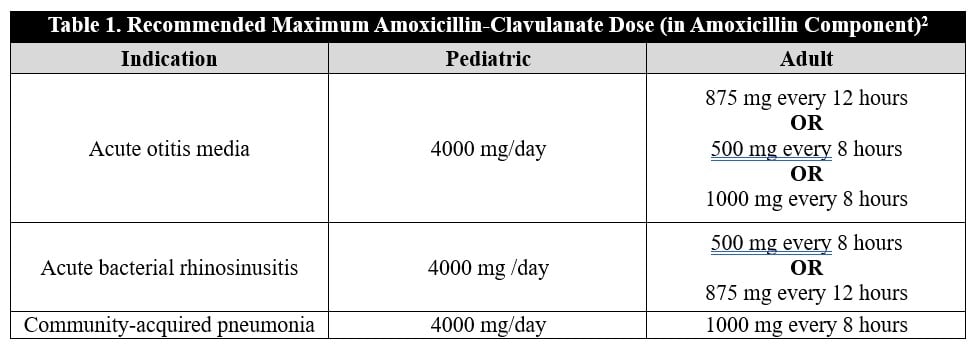
When determining what maximum dose to use for larger pediatric patients, consider adult dosing recommendations for indication, infection severity and formulation availability. Standard‑dose maximums are better established (e.g., 875 mg every 12 hours or 500 mg every eight hours). When using high‑dose regimens, consider one of the following maximums:
- Extended‑release tablets: 2000 mg every 12 hours.
- Immediate‑release formulations: 1000 mg every eight hours.
Determining the most appropriate frequency
Because amoxicillin‑clavulanate exhibits time‑dependent killing, increasing dosing frequency can improve bactericidal activity. Twice‑daily dosing (i.e., every 12 hours) is sufficient for most uncomplicated community infections, including acute otitis media, acute bacterial rhinosinusitis, cellulitis, cystitis and community‑acquired pneumonia.
In certain infections, optimizing the time that concentrations exceed the organism’s minimum inhibitory concentrations may be indicated. In these cases, every‑eight‑hour dosing is preferred:
- Pyelonephritis (to optimize renal parenchymal concentrations).
- Community‑acquired pneumonia in patients with higher pneumococcal resistance (e.g., unvaccinated, community rate >10% of penicillin-resistant pneumococcus).
- Step‑down therapy for more severe infections (e.g., osteomyelitis).
Maintaining consistent dosing intervals is ideal. While minor schedule adjustments are acceptable, keeping doses as close to every 12 or eight hours as possible helps maintain therapeutic concentrations. Patient and caregiver ability should also guide frequency selection; if adherence to three times daily dosing is unlikely, twice daily dosing may be reasonable for non‑severe infections.
Cracking the Ratio Code: Selecting the Right Formulation
Amoxicillin‑clavulanate is available in at least nine formulations with five different amoxicillin‑to‑clavulanate ratios (2:1, 4:1, 7:1, 14:1, 16:1). These variations exist to allow high amoxicillin dosing without excessive clavulanate exposure, which increases gastrointestinal side effects. Higher‑ratio formulations (14:1 and 16:1), such as 600 mg-42 mg/5 mL solution, and 1000 mg-62.5 mg tablets, support high‑dose strategies, while lower‑ratio formulations are intended for standard dosing.
Selecting the correct formulation ensures appropriate clavulanate exposure and minimizes adverse effects.
Summary
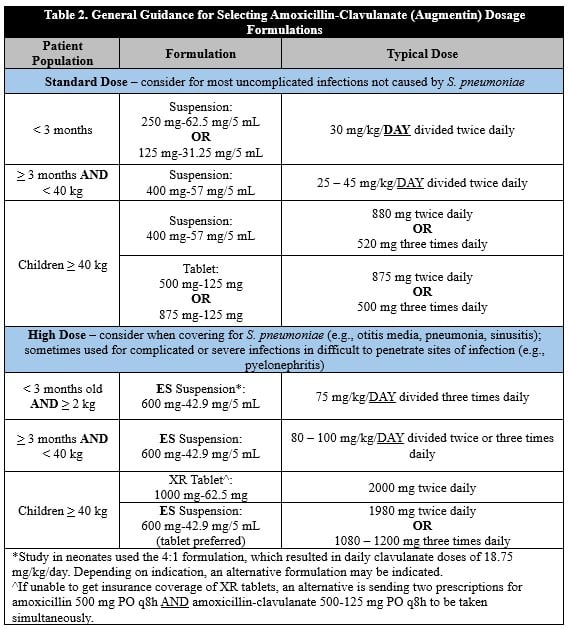
Amoxicillin‑clavulanate dosing can appear complicated due to the drug’s wide dosing range, multiple formulations and varied indications. However, applying a structured approach—selecting the appropriate dose (standard vs. high), choosing the correct frequency (BID vs. TID), and matching the formulation to the dosing strategy—helps ensure effective and well‑tolerated therapy. General guidance principles discussed are summarized in Table 2.
References:
- Yu D, Bio LL. Shedding the light on amoxicillin, amoxicillin-clavulanate, and cephalexin dosing in children from a pharmacist’s perspective. J Pediatr Infect Dis Soc. 2022;11(12):594-602. doi:10.1093/jpids/piac105
- Amoxicillin-clavulanate. In: Pediatric and Neonatal Lexi-Drugs. UpToDate Inc. Updated March 10, 2026. Accessed March 10, 2026. http://online.lexi.com
- Moenster R, host; Lockowitz C, Morton T, guests. Breakpoints: The SIDP Podcast. #130 – Dosing Consult: Amoxicillin. Society of Infectious Diseases Pharmacists; 2024. Accessed March 10, 2026. https://breakpoints-sidp.org/130-dosing-consult-amoxicillin/