Turning 40
Kidney transplant and Camp ChiMer hit a milestone
“There comes a time, when we heed a certain call.”
When that line was first heard in the song “We Are the World,” in 1985, it reflected a moment of shared purpose and compassion. That same year, Children’s Mercy answered its own call — one that would change the lives of children and families across the region.
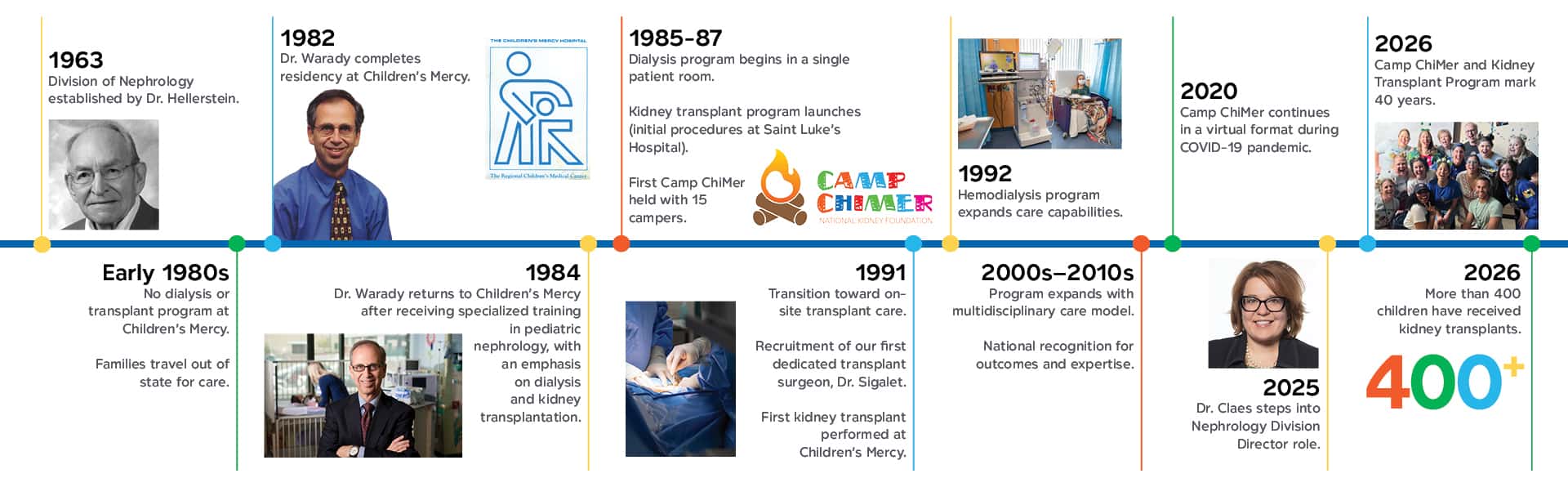
At the time, there was kidney care at Children’s Mercy, but no dialysis program or transplant program. Children with kidney failure often had to leave Kansas City, travel for care and sometimes relocate entirely.
Today, as Children’s Mercy marks the 40th anniversary year of both the Kidney Transplant Program and Camp , that story has been transformed.
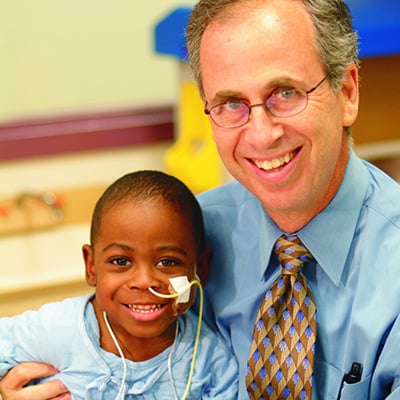
At the center of that transformation is Bradley Warady, MD, Director of Dialysis, Nephrology, and the McLaughlin Family Endowed Chair in Nephrology.
If you build it, they will come
Dr. Warady first recognized the need for local kidney failure care as a pediatric resident at Children’s Mercy in the early 1980s. At the time, children with kidney failure had limited treatment options and none close to home.
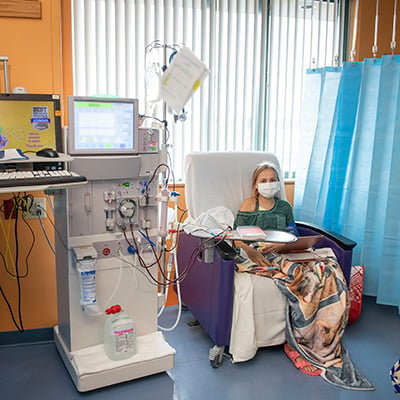
The treatments themselves were still evolving. Dialysis, which takes over the work of the kidneys, was not widely available for children. Some approaches, like peritoneal dialysis, could be done at home using the body’s own abdominal lining to help filter the blood, but this option was still relatively new. Other approaches, like hemodialysis, required specialized equipment and training that simply didn’t exist yet at Children’s Mercy.
After completing his residency in 1982, Dr. Warady pursued specialized training with the goal of returning to Children’s Mercy to help close that gap. When he came back, he worked alongside hospital leadership and his mentor, Stanley Hellerstein, MD, FAAP, who started the Nephrology program at Children’s Mercy in 1963, to bring that vision to life.
In 1985, Children’s Mercy launched its chronic dialysis program.
It began in a single patient room and cared for just two children. Space was limited, and the work required creativity and persistence. “That was our dialysis unit,” Dr. Warady recalled. “That’s all the room we had.”
In those early years, the program focused on peritoneal dialysis, with a small team of physicians and dialysis nurses with support from Nutrition Services, Social Work and Surgery. Hemodialysis was not yet available, and building that capability required new equipment, training and space. Over time, the program expanded, eventually adding hemodialysis in 1992 and evolving into a more comprehensive approach to care under Dr. Warady and nursing leaders including Linda Jones, MHA, BSN, RN, and Amy Nau, MSN, MBA, RN.
Each step built forward momentum.
What started as mighty effort in a shared room became the foundation for a program designed to meet the full needs of children with kidney failure and their families. That determination opened the door to a kidney transplant program that would change lives for decades to come.
A full path for care
Dr. Warady understood that dialysis was only part of the journey for children experiencing kidney failure. For most of those children, dialysis serves as a bridge to transplantation. That meant building both programs together.
“The dialysis program and the transplant program … it’s a package deal,” he explained, reflecting on those early decisions.
The early years required creativity and collaboration. Initially, transplants were performed at Saint Luke’s Hospital with Children’s Mercy physicians collaborating with adult transplant doctors and surgeons.
Over time, the program grew:
- Children’s Mercy recruited its first transplant surgeon, David Sigalet, MD.
- Dr. Sigalet performed the first kidney transplant at Children’s Mercy.
- Procedures moved fully on-site.
- A multidisciplinary care team formed around each child and family.
For families, this meant access to care close to home during one of the most challenging times in their lives.
More than 400 children have now received a kidney transplant through Children’s Mercy and its multidisciplinary transplant team. Each transplant represents a life changed and a future reimagined.
A different kind of need
As the clinical programs expanded, another gap became clear: Children living with kidney disease often felt set apart from their peers. Treatments, medications and medical routines shaped their daily lives in ways others did not experience. Dr. Warady believed that the care we provided should address that issue, as well.
Drawing from his own prior experience working with children as a camp counselor, he envisioned a place where kids could simply be kids — no explanations required. That vision became Camp Chimer.
Camp Chimer held the first of its soon-to-be 40 annual sessions in 1987 with just 15 campers. An initial gift from The Dream Factory made the first experience possible. From the outset, Camp Chimer removed barriers. Dialysis is conducted at camp, and the camp has always been offered at no cost to families. Supported by Children’s Mercy, the National Kidney Foundation and a devoted network of volunteers, Camp Chimer puts the focus on connection, confidence and joy.
“What’s most important … is that the kids get to be with other kids who have been on a similar journey with no questions asked … and that they have a great time,” Dr. Warady shared.
For a few days each year, children are surrounded by others who understand their experiences. There are no questions about medications or treatments. There is no need to explain why they may have multiple surgical scars or why they might be a bit shorter than other kids their age. They simply get to belong.
Behind the scenes, a full care team — including Children’s Mercy physicians, nurses, dietitians, pharmacists and social workers — supports a safe environment while allowing kids to focus on being kids. To campers, it feels like freedom.
The power of coming back
Many campers return as adults to serve as counselors. Some are former transplant recipients. Some were dialysis patients. All bring lived experience that helps guide and inspire younger campers. They become role models. They show what is possible.
As Dr. Warady has seen year after year, the camp becomes something deeper: “It really becomes sort of like a family.”
That cycle of connection has created a community that spans generations and includes Children’s Mercy kidney transplant coordinators Katelyn Walser, RN, BSN, CPN, and Mariah Charland, RN.
Read Katelyn and Mariah’s story
Leadership, legacy and a new chapter
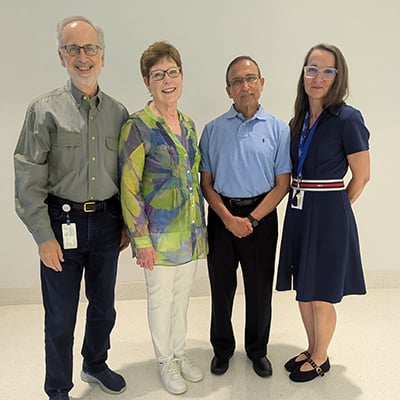
For much of his tenure at Children’s Mercy, Dr. Warady served as Division Director of Nephrology and Director of Dialysis and Transplantation. Under his leadership and the efforts of the entire division membership, the program grew from its earliest days into one recognized nationally and internationally for its expertise and outcomes.
Today, he continues to serve Children’s Mercy as an endowed chair, as well as Medical Director of Dialysis and Medical Director of the Transition to Adulthood Program.
Recently, he chose to step down as Division Director of Nephrology, passing that leadership role to Donna Claes, MD. This moment reflects both the strength of the program he helped build and his continued focus on advancing care in new ways.
His legacy is not defined by a single title, but by the lives changed across decades.
Today, the nephrology program at Children’s Mercy continues to be recognized among the top programs in the country, reflecting years of innovation, collaboration and dedication.
Camp Chimer continues to thrive as well, adapting to meet new challenges while staying rooted in its purpose. Even during the COVID-19 pandemic, the camp experience continued in a virtual format so children could stay connected.
Both programs remain grounded in a shared belief: Children deserve expert care and the opportunity to live fully.
A legacy that extends beyond patients
Dr. Warady’s commitment to care and advocacy reaches beyond the children and families he serves to his colleagues as well.
In recognition of the importance of organ donation, Children’s Mercy established the Bone Marrow and Solid Organ Donor (Warady) Benefit. Named in his honor, the benefit supports Children’s Mercy team members who choose to become living donors by providing additional Extended Illness Time and other support during recovery.
It reflects a broader commitment to removing barriers to donation and supporting those who give the gift of life.
Answering the call, 40 years later
In 1985, Children’s Mercy answered a call to do more for children with kidney failure.
Forty years later, that call continues: to shape everything that follows. Through lifesaving transplants. Through moments of belonging at camp. Through care teams who see each child as more than a diagnosis.
And through a legacy that continues to grow, led by those who built it and those now guiding what comes next.