Karli's Story– Selective Dorsal Rhizotomy Procedure for Cerebral Palsy
Meet Karli
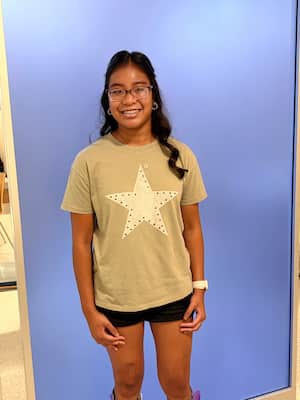
As Karli starts her freshman year of high school, she's ready for questions from her classmates about her purple leg braces and her "battle scars" — long incision scars on her legs that are a remnant of surgeries she had as a child. But the true mark of her most recent procedure, a selective dorsal rhizotomy, isn't in the form of a visible scar, but in her vastly improved ability to walk.
A long journey
Karli's parents, Gina and Travis, adopted her from the Philippines when she was 4 years old. They knew she had cerebral palsy, a condition where the muscles in her legs were extremely tight and prone to spasms, and she walked on her tiptoes due to that tightness. Undeterred, Gina and Travis traveled across the Midwest from their home in Yates Center, Kan., seeking the best treatments for Karli, until they found the Comprehensive Movement Disorders and Spasticity Clinic at Children's Mercy.
After all these appointments and multiple procedures, Travis said, "We didn't want to do anything that could hurt her, because she's been through so much already." But, Gina added: "From the very first appointment we had with that team, we were like 'Yes!' We felt so much better. They spent two hours with us, listened to us and encouraged us."
Karli's team at Children's Mercy included Rose Gelineau-Morel, MD, Pediatric Neurologist; Sathya Vadivelu, DO, Rehabilitation Medicine Physician; and Paige Haynes, MD, Pediatric Neurosurgeon, along with many other supportive team members. "I love that we have the specialists we have in the clinic because it gives a different lens on movement patterns and the source of those movement patterns," said Dr. Vadivelu.
"What's unique about our clinic is that we all assess the patient together — we're getting their history together, examining their muscle tone hands-on,” she added. “We're able to see the same things and collaborate in a more efficient and effective way rather than just verbally communicating what we saw to the other specialists."
Together, Karli's team decided that she would be a great candidate for the selective dorsal rhizotomy (SDR) procedure, a delicate spinal surgery that cuts the parts of the nerves that are triggering excess muscle spasticity in the legs. Although Karli was a little older than most kids who undergo the SDR procedure, "she was very motived, mature and honed in on the process, so we felt that she was in a great place for the procedure," said Dr. Vadivelu.
Dr. Haynes, Karli's neurosurgeon, agreed: "Karli has been through quite a bit in her young life already, but I knew she was going to work hard and would be a good candidate. Her parents are wonderful — so supportive and encouraging for her."
A team effort led by Karli
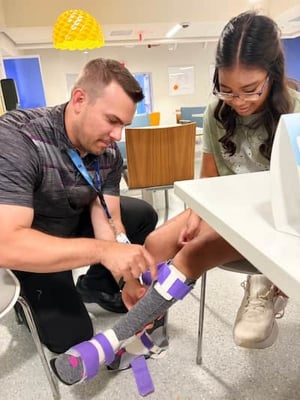
Dr. Haynes always performs the procedure in tandem with a rehabilitation medicine physician who carefully monitors the neurological responses in the patient to determine which nerve roots are safe and appropriate to cut during the procedure. "We were nervous about [the surgery] at first, but we're glad that Karli decided to go through with it," Travis shared. "She's a good role model for kids, after what she's been through, all the surgeries — she's a testament!"
Karli's parents and care team agreed that the final decision was up to her, not only because of the procedure itself, but because she would have several weeks of intensive inpatient rehabilitation afterwards, followed by ongoing outpatient rehab multiple times a week once she was back home. She wanted the surgery.
As it turned out, Karli was a champ at doing the hard work her rehab program required. "Rehab was actually fun," she said. "It was really intense, but I liked the people I did it with, especially the PT people. They're really funny! Sometimes it was hard, and I didn't want to do it, but we had a bond by the end, and it was fun to do it with the other kids, too."
A smooth transition
Having an in-house rehab program is one of the benefits of having the SDR procedure at Children's Mercy. "We're able to transition kids fairly quickly into inpatient rehab so there's not a delay in care," explained Dr. Vadivelu. "Then we assist with the process of transitioning to outpatient care. It's always important to keep kids as local as possible so they have their support system nearby, especially with a long hospitalization and recovery."
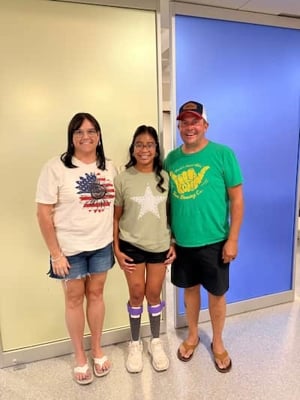
Karli's commitment to her recovery has impressed everyone on her care team. But she is very matter-of-fact about it. "You just have to have determination and don't give up," she said. "It's gonna be a long ride, but you'll get there eventually. It was a little scary, but it was worth it. I had a really good medical team, people I could trust who would see how I was doing."
Gina agreed: "I was scared too, wondering 'Oh my gosh, it sounds like a big deal!' But it was worth it. You take the risk, and you know you're in good hands. I would definitely recommend it. It works!"
There is no better testament to that than Karli herself. After graduating from inpatient rehab at the end of June, she spent her summer swimming, playing basketball and soccer, and hanging out with her friends. Now, she's ready to go to high school football games and pursue her passions for art, science and history in 9th grade.
And her scars from her previous surgeries? "I still get a lot of questions about them, especially from younger kids, but I tell them [about my surgeries], and they think it's awesome and crazy,” said Karli. “They're my battle scars."