
Jaxson's Game Plan: Giving his all to strike out ALL
Meet Jaxson
Touchdown! Home run! Goal! Remission!
Before he's a cancer survivor, Jaxson is a sports kid.
The 11-year-old from Webb City, Mo., can usually be found talking Chiefs football, cheering on the Royals, attending Sporting KC or Kansas City Diamonds games or figuring out how to help another family make it to a sporting event. He's a collector of baseball cards, a champion for childhood cancer awareness and, according to his father, Jeffrey, someone who has "never met a stranger."
What many people don't see is that behind every game, every autograph and every smile is an eight-year battle with acute lymphoblastic leukemia (ALL) that has shaped much of his young life.
A diagnosis no family expects
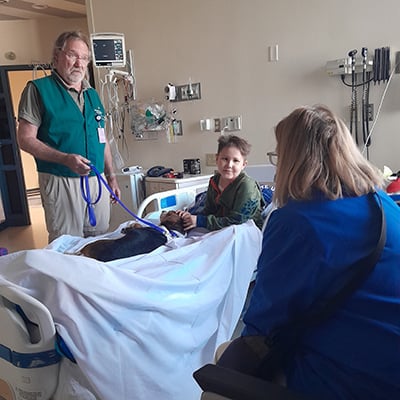
Jaxson's journey began on Dec. 31, 2018. He wasn't feeling well and was taken to see a doctor. Upon examination, things quickly became much more serious as blood tests revealed abnormalities that local physicians knew required immediate specialized care. Within hours, the family learned he needed to get to Children's Mercy as quickly as possible.
The Children's Mercy Critical Care Transport team coordinated his transfer from southwest Missouri, helping bring the then-3-year-old to Kansas City for the specialized care he urgently needed. For Jeffrey, everything happened in a blur.
"It was children's cancer. It's something that nobody's really prepared for," he said.
After additional testing, Children’s Mercy physicians diagnosed Jaxson with acute lymphoblastic leukemia, or ALL.
For families hearing that diagnosis for the first time, the medical terminology can feel overwhelming.
"Acute lymphoblastic leukemia is the most common childhood leukemia," explained Alan Gamis, MD, MPH, pediatric oncologist at Children's Mercy.
ALL begins in the bone marrow, where blood cells are created. It develops when an acquired genetic change occurs, causing immature white blood cells, called lymphoblasts, to multiply uncontrollably and crowd out healthy blood cells.
Dr. Gamis often explains it with a simple analogy:
"Think of it as a copy machine stuck on 'copy.’ Yet that copy machine is making copy machines, not paper."
Without treatment, ALL is life-threatening. Fortunately, advances in pediatric cancer care have transformed outcomes, with cure rates now exceeding 90% for many children diagnosed with the disease.
More than a patient, part of the team
From the beginning, Jaxson's family discovered that cancer care at Children's Mercy is about far more than treating a disease. It means surrounding children and families with an entire team dedicated to helping them navigate the many challenges that come with a cancer diagnosis.
"What sets Children's Mercy apart is our patient-centered focus," said Dr. Gamis. "For every patient, we have an individual team of caregivers they can turn to at any time throughout their therapy."
Each child is paired with a primary oncologist, nurse practitioner and social worker, supported by a multidisciplinary care team that includes child life specialists, pharmacists, nurses and many others. The same team remains connected to each patient throughout treatment and beyond.
For Jeffrey, that comprehensive care became invaluable. "The team was so supportive. We went straight into Jaxson's treatment," he recalled.
Over the years, Jaxson built relationships throughout the hospital.
"Children's Mercy is like a second home to me," Jaxson said.
Three relapses. Countless reasons to keep fighting
Following his diagnosis, Jaxson completed the standard three-year treatment protocol for ALL and finished therapy in December 2021.
Then came the first setback. About eight months later, his leukemia returned. Children's Mercy physicians helped him achieve remission again, and he completed another two years of treatment.
Then it came back again.
And then again.
By 2025, Jaxson had experienced three relapses. Each recurrence required a different strategy and the expertise of specialists across the Children's Mercy Division of Hematology, Oncology and Blood and Marrow Transplantation.
"Jaxson has been fighting leukemia since he was 3 years old," said Lauren Wilson, DO, pediatric blood and marrow transplant physician. "He's seen just about every therapy that there is."
His treatment journey included chemotherapy, targeted immunotherapy, CAR T-cell therapy and an additional immunotherapy called blinatumomab, which helped return him to remission after another recurrence.
Despite every challenge, Jaxson continued being exactly who he had always been.
"He's that wonderful representation of being a kid," said Dr. Gamis. "He carries the weight of having to go through all his therapy, the weight of the potential for his leukemia to come back. Yet he says, 'I'm going to still live my life and enjoy my life regardless of what I'm faced with.' So it’s that resilience, I would say, that defines Jaxson."
The next chapter: A bone marrow transplant
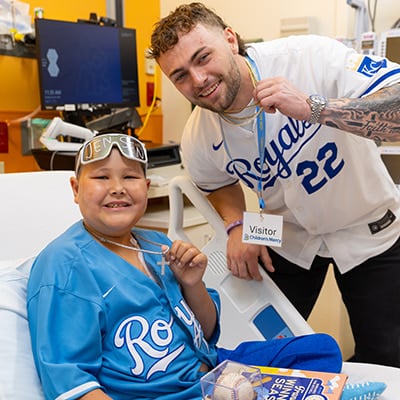
After Jaxson's third relapse, his care team turned to one of the most intense therapies available in pediatric cancer care: a bone marrow transplant. The goal was to replace his diseased bone marrow with stem cells from a healthy donor and give him the best possible chance for a long-term remission.
After family members were tested, Jaxson’s 21-year-old sister was a 50% match, and the best available donor for Jaxson's transplant.
Throughout Jaxson's cancer journey, participating in research whenever possible has also been important, hoping their experience might help other children facing cancer in the future. Whether through tissue samples, bone marrow studies or other research opportunities offered during treatment, Jeffrey says the decision has always been an easy one.
"Maybe 20 years from now, this doesn't have to go on with some other kid that we don't know," he said. "If they can take a little extra bone marrow from Jaxson and try to figure out why something didn't work or what might work better, that sounds like a whole little to do a whole lot."
Before transplant, Jaxson underwent intensive conditioning therapy, including chemotherapy and radiation, designed to eliminate remaining leukemia cells and prepare his body for the new donor cells.
Then came transplant day.
For many families, the term "bone marrow transplant" sounds like a major surgery. In reality, donor stem cells are collected and placed in a plastic bag and infused much like a blood transfusion.
"It's very anticlimactic," Dr. Wilson explained. "The bedside nurses hang the bag of stem cells on an IV pole like we would for any other blood transfusion or IV medication. You don’t have to go to the operating room. It’s all done in their hospital room."
Jaxson spent much of the procedure doing what he does best: challenging Dr. Wilson to video games.
Recovery was harder.
There were difficult days when Jaxson could barely get out of bed. To help motivate him, Jeffrey began bringing packs of baseball cards.
"It wasn't just collecting ball cards," Jeffrey said. "It was a kind of a motivation for him to get out of bed."
Three weeks later, the transplant successfully engrafted, meaning the donor cells had begun producing healthy blood cells.
Today, Jaxson remains in remission and continues to be monitored closely by his care team. While he recovers, he and his father are staying at the Ronald McDonald House, just across the street from Children's Mercy, allowing them to remain close to the hospital while Jaxson attends regular follow-up appointments.
It's a chapter filled with far more baseball cards, sports outings and plans for the future, rather than hospital stays — something both father and son are grateful for.
Using his platform to help others
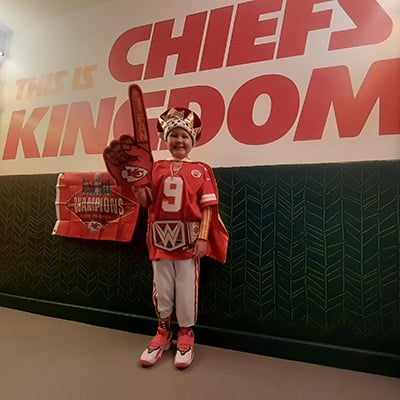
For Jaxson, surviving cancer isn't enough. He wants to help other kids facing similar challenges.
Over the past several years, he has become a passionate advocate for childhood cancer awareness, using sports and community connections to give back.
He organizes Chiefs ticket drives for families staying at the Ronald McDonald House, helps raise awareness for childhood cancer and regularly donates sports memorabilia to support charitable causes. What started as an effort to help three families attend a football game has grown into an annual initiative benefiting dozens of families.
"Jaxson kind of put childhood cancer on his back," Jeffrey marveled. "He loves helping people."
And through it all, he continues doing what he loves most: cheering on his favorite teams, meeting athletes and reminding everyone around him what perseverance looks like.
When asked what advice he would give another child facing cancer, Jaxson’s answer comes without hesitation:
"Never give up, man. The fight's never over. Everybody's always with you."