
Outbreak, Alerts & Hot Topics: Cyclospor-what?!
While the World Cup has dominated the sports scene this summer, a parasite is a surprise contender capturing everyone’s attention. Cyclospora cayetanensis is a parasite causing an intestinal infection called cyclosporiasis. The infection is endemic in many resource-limited areas of the world, with local cases in the U.S. typically associated with fresh produce. It is typical for cases of Cyclospora to increase in the summer months (May-August); however, this year there has been an unusually high number of cases of cyclosporiasis nationally. Let’s dive into the situation and pathogen, keeping in mind there are many other causes of diarrhea that are present in the spring and summer months.
Status of current outbreak:
As of July 23, there have been 4,173 laboratory-confirmed cases nationwide across 41 states. An additional 7,400 cases are currently awaiting confirmation as locally acquired cases of cyclosporiasis.1 In Kansas, 289 cases of cyclosporiasis have been reported, with 148 pending interviews.2,3 In Missouri, 216 cases have been reported.4 By comparison, 249 cases were reported nationally during the same time in 2025. A small subset (7-9%) of this year’s confirmed cases required hospitalization, and no deaths have been reported thus far. Importantly, the true number of cases is likely higher as cyclosporiasis is often underdiagnosed and underreported. Patients involved in this outbreak developed their symptoms without a history of travel and with consumption of food within the United States. Iceberg lettuce has been implicated in at least 5 states as the source of the outbreak.1 There has been one recall so far from Taylor Farms and their products containing iceberg lettuce sourced from central Mexico.5 However, the investigation is still very much ongoing. Past outbreaks within the U.S. have been linked to raspberries, basil, cilantro, snow peas and mesclun lettuce.6,7
Clinical presentation:
Cyclosporiasis presents with watery, non-bloody diarrhea that can be profuse, protracted, intermittent and at times “explosive.” Systemic symptoms can accompany gastrointestinal manifestations and can include anorexia, nausea, cramping, weight loss and dehydration. Symptoms start two to 14 days after exposure. Illness can be severe and dramatic, though is usually not life-threatening.8 Transmission is via ingestion of food or water contaminated with mature Cyclospora oocysts from feces. The oocysts excreted during illness require maturation outside of humans (one to two weeks minimum) before they are infectious to anyone else. As such, person-to-person spread is unlikely.9 Humans are the only host for C. cayetanensis.
Diagnosis:
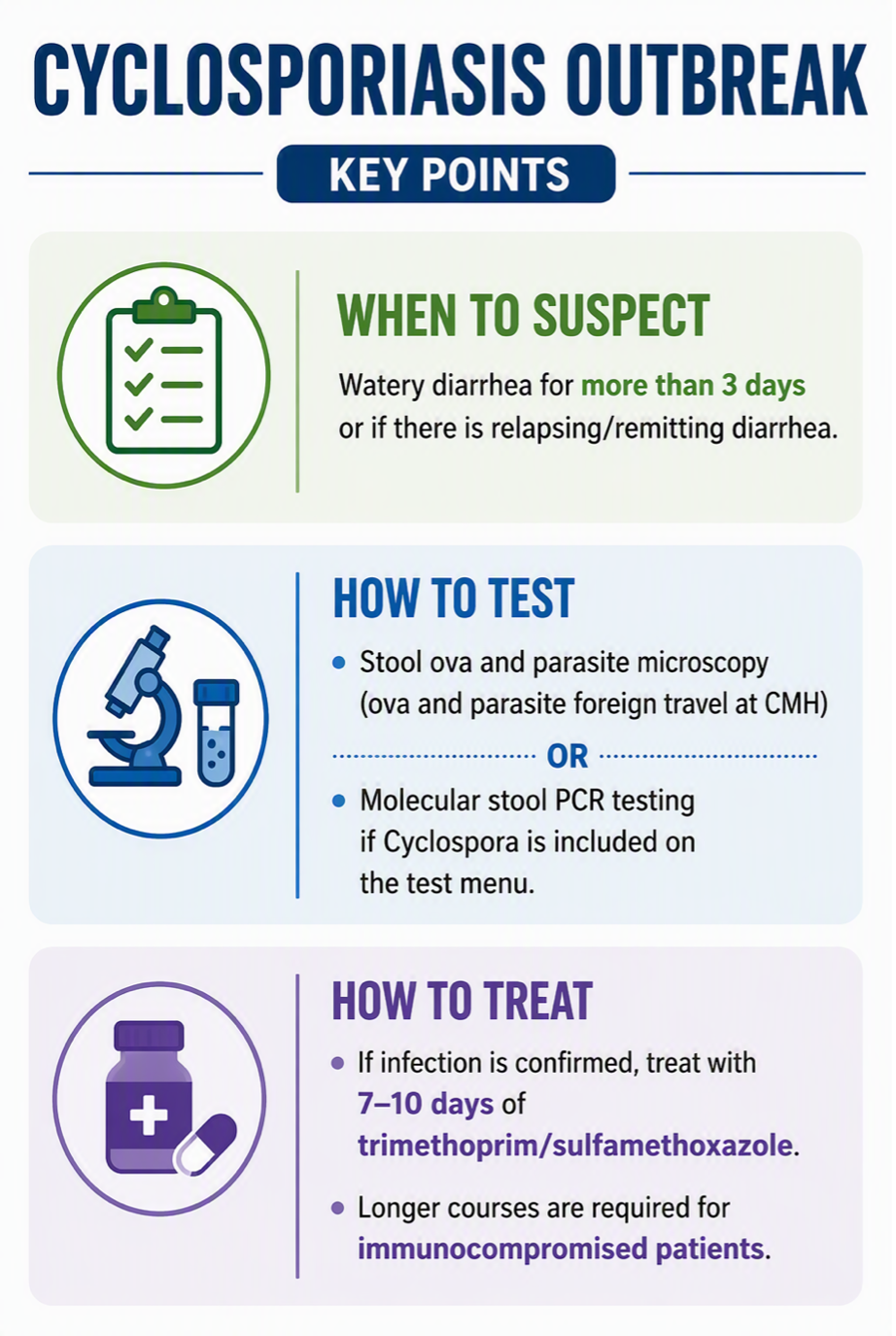
Diagnosis of cyclosporiasis can be made based on identification of oocysts with manual inspection of samples or via molecular testing.6,9 To visualize the parasite, specialized stains are required. This specialized stain is only completed when the “Ova and Parasite Foreign Travel” test is ordered at Children’s Mercy Hospital (CMH). The standard Ova and Parasite orderable test will not detect Cyclospora oocysts. The oocysts can also be shed in variable amounts, so repeat stool examinations may be required as is standard practice when looking for intestinal parasites in general. Additionally, there are molecular methods to detect Cyclospora such as multiplex PCR panels, which can have a rapid turnaround time and at times enhance detection. If ordering a molecular test, be sure to check if Cyclospora is present on its menu, as not all panels include it. Additionally, keep in mind these are high-cost tests with questions about outpatient coverage for reimbursement, and they may detect other pathogens that are irrelevant or falsely positive.
Treatment:
Most infections are self-limited, though the U.S. Centers for Disease Control recommends treatment of confirmed cases of cyclosporiasis with trimethoprim-sulfamethoxazole (TMP-SMX).6,8 For patients above 2 months of age, dosing is 8-10 mg of TMP/kg/day divided every 12 hours (4-5 mg of TMP/kg/dose) with max dosing of one double-strength tablet per dose (160 mg of TMP). Duration of therapy is seven to 10 days, with longer courses required for immunocompromised patients. There are no other alternatives that have been identified, though case reports have described successful use of alternative agents such as nitazoxanide or ciprofloxacin.10
Prevention:
Risk of infection can be decreased, though not fully eliminated, by thoroughly washing fresh produce under running water before consumption, even if it is labeled pre-washed.11 Cooking vegetables to a temperature of 158°F kills the parasite. Chemical disinfectants, baking soda, vinegar and sanitizing products may not fully eliminate Cyclospora, as the oocysts are resistant to most disinfectants. This highlights the importance of good hand hygiene and avoidance of food or water that may be contaminated or more likely to be contaminated with Cyclospora, especially for higher-risk individuals.
Resources:
American Academy of Pediatrics Redbook Online- Cyclosporiasis Outbreak Information
Centers for Disease Control Clinical Overview of Cyclosporiasis
Centers for Disease Control- Health Alert for Domestically Acquired Cyclosporiasis Cases
Parent and Patient Friendly Information about Cyclosporiasis from the American Academy of Pediatrics
References:
- Surveillance of Cyclosporiasis. Centers for Disease Control and Prevention. July 21, 2026. Accessed July 23, 2026. https://www.cdc.gov/cyclosporiasis/php/surveillance/index.html
- Domestic and international infectious disease report July 15, 2026. Kansas Department of Health and Environment. July 15, 2026. Accessed July 16, 2026. https://www.kdhe.ks.gov/DocumentCenter/View/59784/Weekly-Domestic-and-International-Infectious-Disease-Report-7-15-2026-PDF
- Cyclosporiasis Surveillance Data. Kansas Department of Health and Environment. July 21, 2026. Accessed July 23, 2026. https://www.kdhe.ks.gov/2458/Cyclosporiasis-Surveillance-Data
- Missouri Communicable Diseases Report (2026). Missouri Department of Health and Senior Services. July 19, 2026. Accessed July 23, 2026. https://data.mo.gov/Health/Missouri-Communicable-Disease-Report-2026-/fk75-fa28/data_preview
- Taylor Fresh Foods Recalls Iceberg Lettuce from Central Mexico Because of Possible Health Risk. United States Food & Drug Administration. July 18, 2026. Accessed July 23, 2026. https://www.fda.gov/safety/recalls-market-withdrawals-safety-alerts/taylor-fresh-foods-recalls-iceberg-lettuce-central-mexico-because-possible-health-risk
- Domestically acquired cyclosporiasis cases in multiple U.S. States, 2026. Centers for Disease Control and Prevention. July 14, 2026. Accessed July 16, 2026. https://www.cdc.gov/han/php/notices/han00531.html
- U.S. Food and Drug Administration. July 16, 2026. Accessed July 16, 2026. https://www.fda.gov/food/foodborne-pathogens/cyclospora
- Committee on Infectious Diseases, American Academy of Pediatrics. Cyclosporiasis. In: Kimberlin DW, Banerjee R, Barnett ED, Lynfield R, Sawyer MH, eds. Red Book: 2024–2027 Report of the Committee on Infectious Diseases, Committee on Infectious Diseases. 33rd ed. American Academy of Pediatrics; 2024.
- Clinical overview of cyclosporiasis. February 29, 2024. Centers for Disease Control and Prevention. Accessed July 16, 2026. https://www.cdc.gov/cyclosporiasis/hcp/clinical-overview/index.html
- Committee on Infectious Diseases, American Academy of Pediatrics. Drugs for parasitic infections. In: Kimberlin DW, Banerjee R, Barnett ED, Lynfield R, Sawyer MH, eds. Red Book: 2024–2027 Report of the Committee on Infectious Diseases, Committee on Infectious Diseases. 33rd ed. American Academy of Pediatrics; 2024.
- Preventing cyclosporiasis. Centers for Disease Control and Prevention. July 23, 2026. Accessed July 23, 2026. https://www.cdc.gov/cyclosporiasis/prevention/index.html