
After a Lifetime of Pain, Tim is First Children’s Mercy Patient on Gene Therapy Journey for Sickle Cell Disease
Meet Tim
Pain.
Intense. Sharp. Continuous. Unrelenting. Pain.
For Tim, a sickle cell pain crisis, medically known as a vaso-occlusive crisis (VOC), isn't just discomfort. It's pain so intense it can bring life to a halt.
Other times, he said, the pain feels like "somebody really big is sitting on your chest," making it difficult to breathe.
Tim has lived with sickle cell disease since he was 1 month old. The inherited blood disorder has shaped nearly every chapter of his life, bringing frequent hospitalizations, missed school days, surgeries and complications that most young adults never have to consider. In 2025 alone, Tim was admitted to the hospital approximately 11 times because of severe pain crises. After a lifetime of battling the disease, he is now making history as the first Children’s Mercy patient to receive gene therapy for sickle cell disease, marking a milestone both for him and for the future of care at Children’s Mercy.
A lifelong battle
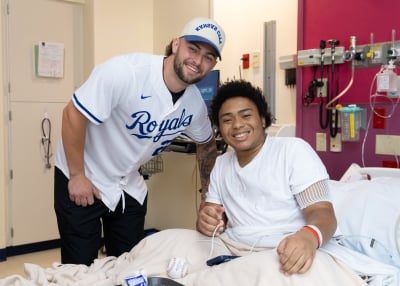
Diagnosed shortly after birth, Tim became a familiar face at Children’s Mercy. Hospital admissions, blood transfusions and pain management became part of his routine. Despite the challenges, he developed a determination that impressed his care team. Over the years, he learned how to advocate for himself, take ownership of his health and navigate the realities of a chronic disease that follows patients everywhere, from classrooms and family vacations to major life milestones.
"I missed so much school," Tim recalled. Yet he refused to let sickle cell disease define him. Even when complications from the disease led to hip surgery shortly before prom, he worked relentlessly to regain his mobility so he could attend. "I wasn't sure I was going to be able to make it," he said. "I was still having trouble standing on my own two feet." Ultimately, he made it to prom and graduated from high school in 2024. Looking back, Tim says one thing has always remained true: "I never let sickle cell keep me down."
Sickle cell disease is an inherited blood disorder caused by a change in hemoglobin, the protein in red blood cells responsible for carrying oxygen throughout the body. Instead of remaining round and flexible, red blood cells become rigid and sickle-shaped. Those cells can block blood vessels, reducing oxygen flow and causing severe pain as well as serious complications affecting organs throughout the body.
Shabnam Arsiwala, MD, director of the Sickle Cell Disease Program at Children’s Mercy, explains that sickle cell disease affects much more than blood. "Because blood flows everywhere, it can affect every organ of the body," she said. "It can cause pain crises, stroke, vision loss, acute chest syndrome, kidney disease and many other complications." Sickling occurs continuously, but certain triggers such as illness, infections, weather changes or physical stress can dramatically increase its severity and cause patients to enter crisis.
While many patients live full lives with medication and supportive care, Tim's disease remained particularly severe. According to Dr. Arsiwala, his 11 hospital admissions in a single year placed him among the most medically complex patients in Children’s Mercy's sickle cell population.
"We saw that his disease was very complex," Dr. Arsiwala said. "He was getting admitted for pain crises quite a lot, and that was limiting his potential and what he could do for himself and for his growth as a person." At the same time, she witnessed something equally important: Tim's readiness. She described him as responsible, accountable and increasingly independent in managing his health care. Those qualities helped make him an ideal candidate when the conversation turned to a groundbreaking new treatment option.
A new possibility: gene therapy
That conversation began in 2025.
Members of Tim's care team approached him and his parents, Tasha and Tim Sr., to discuss gene therapy, a treatment designed to fundamentally transform how sickle cell disease behaves in the body. They reviewed the risks, benefits and lengthy treatment process. Tim and his family took time to learn about the therapy and ultimately decided to move forward.
Considering this a phenomenal opportunity for their son’s future, Tasha said, "For our son to even have a chance at a regular life, it's mended the little patches of broken heart we've had throughout the years."
Tim recalled his excitement: "I said yes, I would love to. I'd be very interested."
For Tim, saying yes launched a journey that has been underway for nearly a year and continues today.
Unlike traditional treatments that manage symptoms, the gene therapy Tim is receiving, called CASGEVY®, works by using a patient's own blood stem cells. Those cells are collected, sent away for specialized gene editing and then returned to the patient after chemotherapy preparation. The process increases production of fetal hemoglobin, a powerful form of hemoglobin present before birth that can help prevent red blood cells from sickling.
The science behind the treatment is complex. The hope behind it is simple.
"The thought is that he won't need to come into the hospital for vaso-occlusive crises anymore," said Jean Freudenthal, PharmD, Advanced Therapeutics Program Director at Children’s Mercy. "This is about improving quality of life and allowing someone to get back to normal things."
Building a gene therapy program
For Dr. Freudenthal, Tim's treatment represents far more than a single patient milestone. She was hired to help build Children’s Mercy's Advanced Therapeutics Program and establish the infrastructure necessary to bring cutting-edge cell and gene therapies to patients across multiple specialties. The work required years of planning, coordination and partnership across disciplines.
"This is a huge milestone," Dr. Freudenthal said when discussing Tim becoming the hospital's first sickle cell gene therapy patient. "Tim is our first patient receiving gene therapy for sickle cell disease, and hopefully he is only the beginning."
Preparing Tim for treatment has required a highly coordinated effort involving specialists in hematology, bone marrow transplant, nursing, pharmacy, psychology, social work, rehabilitation medicine, pain management and numerous other team members. After consenting to treatment, Tim began months of preparation that included stopping his hydroxyurea therapy, receiving red blood cell exchanges, and undergoing stem cell collection so his cells could be edited and manufactured for infusion. Tim needed only one cell collection cycle as opposed to an average of two to six cycles in clinic trials, moving Tim’s case faster than many patients experience. His cells were then sent for manufacturing before being returned to Children’s Mercy for the next phase of treatment.
For Tim, the process has been worth it, even when it has been difficult.
"The hardest part for me has been the blood transfusions," he said. Years of medical procedures have made finding veins increasingly difficult, often turning routine visits into hours-long appointments. Yet he has remained focused on what comes next.
A transformative future
The outcome physicians hope to achieve with this treatment is often described as transformative.
Rather than turning off the gene responsible for sickle cell disease, the gene-editing process reactivates fetal hemoglobin production. The result is a dramatic decrease in the impact of the disease and the possibility of eliminating future pain crises and many complications associated with sickle cell disease.
"We call it transformative therapy," Dr. Arsiwala said. "The disease burden is not there anymore because fetal hemoglobin becomes so powerful." While previous organ damage caused by sickle cell disease cannot be reversed, new complications may be prevented, and many patients experience dramatic improvements in quality of life.
Clinical studies have produced encouraging results. Among participants ages 12 to 35 who received CASGEVY® and had sufficient follow-up, 93.5% experienced no severe vaso-occlusive crises for at least 12 consecutive months after treatment. Researchers have also reported dramatic reductions in hospitalizations related to sickle cell disease.
Looking beyond sickle cell
Those statistics are significant to physicians and researchers.
For Tim, they mean something much more personal.
He dreams about earning his CNA certification and nursing license. He hopes to help other patients living with sickle cell disease, drawing on his own experiences as someone who has spent nearly his entire life around hospitals and nurses. Maybe most importantly, he wants the chance to do ordinary things without worrying whether they will trigger a medical crisis.
One memory stands out.
Several years ago, Tim finally saw the ocean for the first time during a trip to Florida. Excited to experience it up close, he rolled up his pant legs and stepped into the water. The sudden temperature change triggered one of the worst pain crises of his life.
After treatment, he hopes for a different outcome.
"I want to go back to the ocean," he said.
For most people, walking along a beach is an ordinary experience. For Tim, it represents something much bigger: freedom from a disease that has shaped every chapter of his life.
As the first Children’s Mercy patient to begin gene therapy for sickle cell disease, Tim is helping open a new chapter not only for himself, but also for the patients and families who will follow. And for the first time in a long time, the future he imagines is defined less by hospital admissions and pain crises and more by possibility.