
Treating SMA Type 1 Before Birth: Everett’s Story
Meet Everett
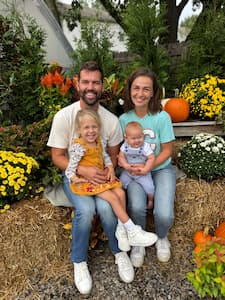
A diagnosis the family understood
Lauren and Austin already knew what spinal muscular atrophy (SMA) type 1 could mean for a newborn. Their oldest daughter, Eiley, was born with very little muscle tone and needed help taking her first breath. When her newborn screening came back positive for SMA type 1, her parents were told every day mattered.
The condition affects the nerve cells that control muscles. Without early treatment, babies can lose strength needed for breathing, eating and movement. Eiley received gene therapy soon after birth, but her first year still brought sleep studies, BiPAP support, respiratory concerns and constant vigilance.
“Everything that has to do with basic life such as eating, sleeping and even breathing, was hard,” Austin said. As first-time parents, it was a lot.
A new pregnancy, a new possibility
When Lauren became pregnant with Everett, early screening showed a high risk for SMA type 1. An amniocentesis confirmed the diagnosis the week of Thanksgiving.
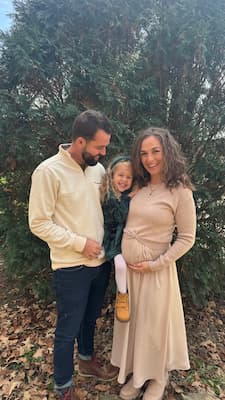
“When we heard that news, it took our breath away again,” Lauren said. “We always knew the possibility. We knew the risks.”
At first, the family expected Everett’s first days to look like Eiley’s: little movement, respiratory concerns and an urgent race to start treatment after birth. But before pregnancy, they learned prenatal treatment with risdiplam, an SMA medication, might be possible.
“When I first heard prenatal treatment could be possible, I was like, what do we need to do to make this happen?” Lauren said. “If it could be life changing, I wanted to do it.”
The family asked questions, talked with physicians and weighed the unknowns. They wanted to understand the risks, especially for Lauren during pregnancy. They already understood the urgency of treating SMA as early as possible.
Care that moved with urgency
The Richards family found support at the Elizabeth J. Ferrell Fetal Health Center at Children’s Mercy. Lylach Haizler-Cohen, MD, a maternal-fetal medicine physician and clinical geneticist, worked with the family and helped coordinate a complex plan of care.
“She was so genuine and sweet and cared about you as a human being with real needs and real emotions,” Lauren said. “She was fighting right alongside us.”
Beginning around 26 weeks, Lauren took risdiplam every morning. She came to Children’s Mercy each week for ultrasounds, bloodwork and monitoring. The care team watched Lauren’s health closely and checked Everett’s growth and well-being throughout treatment.
The treatment was still new, and the family knew there were unknowns. But they also felt supported by a team that respected their hope and stayed honest about the uncertainty.
Born breathing, crying and moving
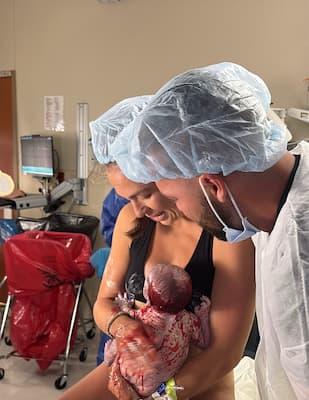
When delivery day arrived, everything moved quickly. Lauren went into labor, and three hours later Everett was born.
“He had strength, he had tone and he had muscles, and he could breathe for the first time all by himself,” Lauren said. “I remember saying, ‘It worked.’”
Austin noticed it, too. Everett’s arms moved with strength. His cry was loud and clear, a sound that brought relief after months of waiting.
“You hear the cry and you see his arms moving, and it’s just a sigh of relief,” Austin said. “All the work, all the conversations, all the advocating — we were here.”
For Lauren, the moment felt healing. Eiley’s birth had been followed by fear, urgent decisions and a race against time. Everett’s birth gave the family space to breathe and bond.
Finding strength in everyday moments
Everett’s early assessments brought more encouraging news. The team checked how his nerves and muscles were communicating and monitored markers related to SMA. Lauren said the results helped confirm what she had seen in the delivery room.
At home, Everett continued to surprise his family in ordinary but meaningful ways. He ate, slept and breathed like they had hoped he would. After Eiley’s difficult first year, those everyday rhythms felt extraordinary.
Everett will continue to be followed by the SMA clinic as he grows. Because prenatal treatment for SMA type 1 is still emerging, the family knows there is more to learn. But they are moving forward with hope.
Hope for other families
Lauren and Austin want other families facing a prenatal SMA diagnosis to know they are not alone and that new options may be possible.
“There’s hope,” Lauren said. “I would want them to know about this as soon as possible.”
They also hope their experience helps make the path easier for the next family.
“Hopefully we’ve paved some type of way through,” Lauren said. “We want the word to spread because it’s life changing.”
For the Richards family, Children’s Mercy offered more than medical expertise. The team offered careful monitoring, coordinated care and a willingness to walk beside them through uncertainty. For Everett, that meant a stronger start to life.