Digital Ischemia: Guidance for Administration of OnabotulinumtoxinA (Botox®)

Note: Botox® will be ordered and administered by orthopedic hand surgeon 

Preparation Steps:

  • Evaluate need for sedation
  • Gather supplies
    • Botox 100 unit vial
    • 0.9% NS (injectable) vial
    • Alcohol swabs
    • 5 cc syringe x 1
    • 18 G needle x 2
    • 1 cc TB syringe x 1
  • Dilute vial
    • Add 4 mL NS to 100 unit Botox vial (2.5 units/0.1 mL)
    • Assign a 1 hour expiration to vial


Dosing Recommendations (must be individualized):

  • Administer 25 - 55 units per extremity, divided into multiple injections
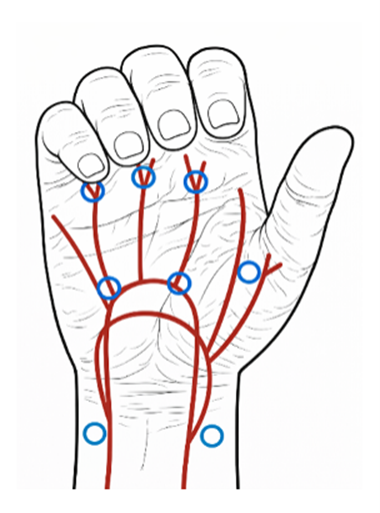
    • Hand (max of 8 total injections)
      • Up to 4 x 5 unit (0.2 mL) injections to interdigital spaces
      • 2 x 5 unit (0.2 mL) injections to superficial palmar arch
      • 2 x 10 unit (0.4 mL) injections adjacent to radial and ulnar arteries
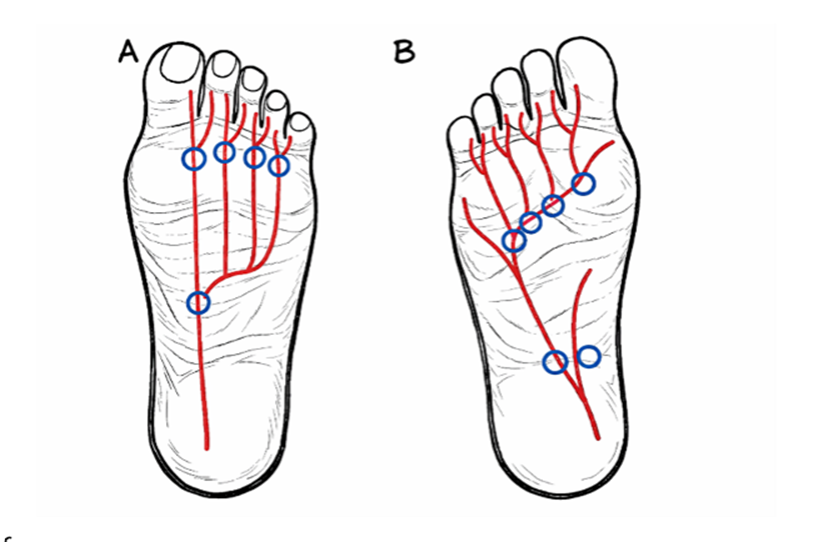
    • Foot (max of 11 total injections)
      • Up to 4 x 5 unit (0.2 mL) injections to dorsal interdigital spaces
      • 1 x 5 unit (0.2 mL) injections to bifurcation of dorsalis pedis arteries
      • 4 x 5 unit (0.2 mL) injections adjacent to the common plantar digital arteries
      • 2 x 5 unit (0.2 mL) injections adjacent to bifurcation of the medial and lateral plantar arteries
  • Recommended injection depth is 2 – 5 mm for all sites
  • Cumulative max of 10 units/kg or 340 units per session


Injection sites (images adapted from Huang et al1 using ChatGPT2)


            Figure 2: (A) Dorsal surface (B) Plantar Surface

References:
1. Huang S, Byrd D, Laarakker A, Shahriari S, Borah G. Successful Treatment of Extracorporeal Membrane Oxygenation Induced Digital Ischemia in Infants Using Botulinum Toxin Type A. Asaio j. Jul 15 2025;doi:10.1097/mat.0000000000002510
2. ChatGPT Version December 11. OpenAI; 2025. https://chat.openai.com/


These pathways do not establish a standard of care to be followed in every case. It is recognized that each case is different, and those individuals involved in providing health care are expected to use their judgment in determining what is in the best interests of the patient based on the circumstances existing at the time. It is impossible to anticipate all possible situations that may exist and to prepare a pathway for each. Accordingly, these pathways should guide care with the understanding that departures from them may be required at times.