
Pediatric Residency Program


A rewarding residency? Challenge accepted.
We’re devoted to the wellbeing of children and we’re looking for incoming pediatric residents who share our values and mission.
We provide resources to support you and customize your pediatric residency experience. Whether you focus on community pediatrics or a subspecialty fellowship, our diverse and expert faculty will mentor you along the way – sharing your goals, helping you hone your skills and preparing you for the future. With this well-rounded support you will be able to focus on what matters most: providing the highest level of care for pediatric patients.
All about us
Children’s Mercy is consistently ranked among the best children’s hospitals by U.S. News and World Report. We’re proud to rank in all 10 specialties, and nine of our specialties rank among the top 30 programs in the United States. For the past 10+ years, Children’s Mercy has been ranked as one of the best places to work in Kansas City. As a vibrant city with a traditional Midwestern feel, Kansas City is balanced with a thriving economy of small businesses, tech start-ups and headquarters of major companies including Hallmark, Cerner and H&R Block. Each year, Kansas City receives national rankings for livability, affordability, innovation and technology, culinary arts (especially barbecue!!) and the fine arts.
About the residency program
- Complex Cases: as a regional pediatric referral center. we commonly see the most complicated diagnoses
- 9,200 + surgical cases
- 12,500 + admissions
- 131,700 + Emergency/ Urgent Care visits
- 4,600 + transports
- Learn from leaders: over 850 faculty pediatric subspecialists
- Founded in 1897 by a female physician and a female dentist, the Berry sisters. Today, we strive to create a community where all feel welcome and supported.
Your wellbeing matters
We believe creating a world of wellbeing for children begins with the wellbeing of our future pediatricians and pediatric subspecialists. Our program is designed to bring balance to your training experience through a culture of support. Read about our wellness program.
Salary and benefits
2025-26 salaries
- PGY1: $71,406.40
- PGY2: $73,902.40
- PGY3: $76,710.40
Benefits for residents
- Annual education stipend
- Paid orientation
- $500 towards Pediatric Boards
- Step III USMLE/COMLEX fee paid - one time
- International elective stipends
- Free covered, on-site parking
- Housestaff lounge with flat-screen TV, kitchen, classroom and library
- Membership dues to the American Academy of Pediatrics
- MedStudy books provided
- $2,250 per year towards travel related to presenting scholarly activity or to cover board review courses
- Catered lunches
- Moving allowance of $500 from outside the Kansas City metro area (subject to taxes)
- Annual resident retreats
- Individual call rooms
- Allocated call money for meals during call shifts
- Discounted tickets to community attractions including movie theaters, amusement parks, bus passes, etc.
Research
The Pediatric Residency Program at Children’s Mercy is committed to providing research opportunities and mentorship support for research to pediatric residents. The Residency Program’s goal is to match interested residents with research mentors. Additionally, the program provides education for residents interested in research and works with the Children’s Mercy Research Institute to collaborate on resources to maximize research success. Learn more about your research opportunities.
Unique experiences
Global Health
The Global Health Track is a two-and-a-half-year program, running concurrently with residency that will offer you further education in global health and prepare you for the opportunity to travel abroad. Most importantly, you will learn about global health, develop effective programs around the world, and learn about how you can incorporate global health into your lifelong career whether that be general pediatrics, a subspecialty, or even living overseas.
Child Health Systems and Community Collaboration Tracks
There are additional educational opportunities available for residents who are passionate about improving the systems that impact child health and well-being and would like to take leadership roles throughout their careers.
CHiCOS Clinic
The Clínica Hispana de Cuidados de Salud (CHiCoS) sets Children’s Mercy apart by offering a unique, formal program for learning medical Spanish as part of a resident’s weekly continuity clinic. In addition to developing bilingual language skills using a formal curriculum, CHiCoS residents learn how to provide culturally-appropriate support for the growing Spanish-speaking community of Kansas City.
Apply for the program
Each year we accept:
- 27 Categorical Pediatric Residents
- 1 Preliminary Pediatric Resident
- 6 Internal Medicine/Pediatric Residents
- 3 Combined Pediatric/Child Neurology Residents
Our program only accepts applications through ERAS and is listed under Children’s Mercy Hospital. All positions are filled through the National Residency Matching Program.
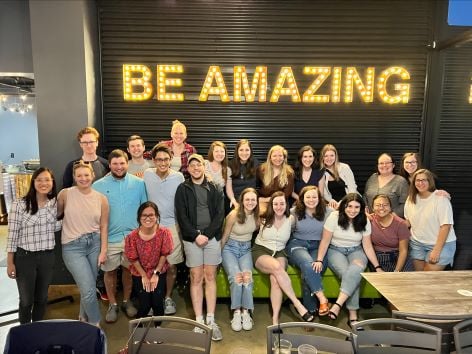
“It’s about you”
“This is a place that allows you to perform. That supports you. It’s about you, not about them. At other places, trainees can work so much and so hard that they can’t learn. They miss out. Here, they hear our voices. The program is designed to learn.”
— Current Resident
Our Pediatric Residency Program leadership team
Ross E. Newman, DO
Program Director
renewman@cmh.edu
Angela D. Etzenhouser, MD
Associate Program Director
aetzenhouser@cmh.edu
Emily F. Killough, MD
Associate Program Director
efkillough@cmh.edu
Danielle Reed, MD
Associate Program Director
djreed@cmh.edu
Shelby Kaup, MBA, C-TAGME
Residency Manager
programcoordinator@cmh.edu
Amber Bellinghausen, BS
Program Coordinator
programcoordinator@cmh.edu
Erin Harris, BBA
Program Coordinator
programcoordinator@cmh.edu