Andrea Bradley-Ewing, MPA, MA
Director, Community Engagement Research, Health Services & Outcomes Research
Full Biography
For many families in the Kansas City community, Children’s Mercy is synonymous with excellent specialty and primary care. The Community Engaged Research team is working to increase awareness so that families also understand the groundbreaking pediatric health research that is happening here.
In August 2024, the Community Engaged Research team launched Science Days — a program providing children and families an opportunity to learn about the notable scientific discoveries happening at Children’s Mercy every day. Through this initiative, Children’s Mercy Research Institute (CMRI) scientists share information on current research studies through age-appropriate, interactive activities for children. For example, the team shared how researchers at CMRI are using genetic information from DNA to help diagnose rare conditions in children through the Genomic Answers for Kids program. To demonstrate how researchers extract DNA, the Community Engaged Research team led children and their families in a DNA extraction activity using strawberries, blueberries and bananas. Children were asked to compare the different fruit DNA to resemble how Children’s Mercy scientists analyze DNA characteristics to identify rare health conditions in children.
Science Days in Kansas City
Science Days was initially launched as a monthly Friday activity at The Regnier Family Wonderscope Children’s Museum of Kansas City. The program was expanded based on feedback from members of the CMRI Community Advisory Board (CAB) — a group of caregivers and community members who offer unique experiences and perspectives on planned and ongoing research.
Andrea Bradley-Ewing, MPA, MA, the Senior Director of Community Engaged Research in the Division of Health and Services Outcomes Research, and her team shared the project with the CAB and members provided feedback on ways to improve the program. While CAB members were excited and supportive of Science Days, they recognized that Wonderscope’s location in a high-resource area of south Kansas City and admission fees could be a barrier for many families with financial and transportation needs. CAB members highlighted the need to expand the Science Days program into more low-resource communities, which was well aligned with the overarching goals of CMRI.
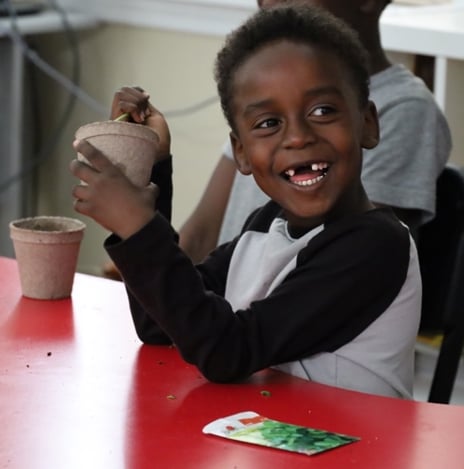
Jessica Welch is a CAB member and program manager for Phoenix Family, a non-profit organization serving around 5,500 families in affordable housing communities. She suggested forming a partnership to expand Science Days reach to families in the Parvin Estates community, located in North Kansas City. Now, elementary and middle school aged children can learn about research at Children’s Mercy right in their own apartment community.
To help cover costs associated with the expansion, Community Engaged Research team member Karynn Glover, PhD, Post-Doctoral Research Fellow, Research Associate; Roxie Montgomery, Help Instill the Key to Education (HIKE) Program Manager at Phoenix Family; and Jessica Welch applied for and received a Broderick Crawford Community Partnership Award through Frontiers Clinical & Translational Science Institute.
Junior scientists experience real-life science experiments
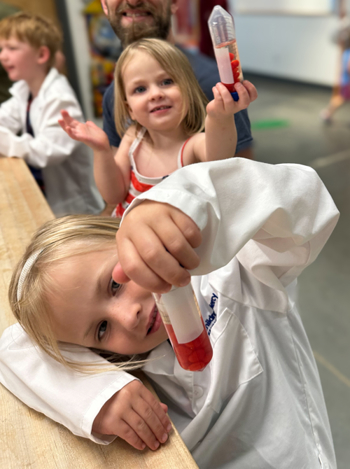
Participants in Science Days are referred to as “junior scientists” as they work through their own scientific experiment. A popular experiment explored precision medicine and how the Genomic and Ontogeny-Linked Dose Individualization and cLinical Optimization for Kids (GOLDILOKs) initiative at Children’s Mercy is personalizing medicine to meet the unique needs of each child. To better understand why finding the right dose is important in medicine, children explored how adding different doses of activator while making slime resulted in undesirable or ideal reactions. Similar to the balancing act of dosing medication, if a junior scientist added too much or too little activator (contact lens solution) to a mixture of water and glue, the slime would have unwanted side effects like becoming unusually stiff or runny. The act of carefully measuring the slime activator parallels how a dose of medication that is too low or too high for an individual child may lead to unwanted side effects.
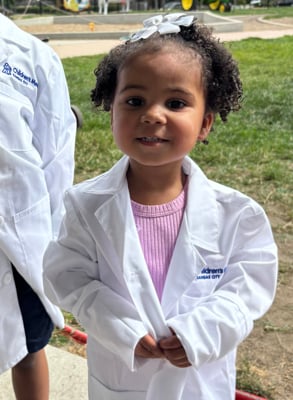
While conducting experiments, junior scientists proudly wore Children’s Mercy lab coats accessorized with safety glasses and clipboards. “They take it very seriously; they might be working with glue and vinegar, but (in their minds) they are working with blood and body fluid — they are so entrenched in the entire process,” said Montgomery.
Science Days increases awareness in CMRI research
Many families in the Kansas City area have never participated in a research study, which may be due to limited opportunities and concerns about the research process. Families are often presented with research studies in a clinical setting where parents may be worried about their child’s illness or pressed for time. Science Days creates a positive association with pediatric research studies by giving families a chance to connect with researchers and ask questions away from possibly stressful clinical settings.
During Science Days, parents have shared that they don’t know much about the types of research being conducted at CMRI and expressed interest in learning more. Bradley-Ewing’s team is hoping to build a bridge between the CMRI and community members who otherwise may not participate in a research study.
“When parents have questions about research at CMRI, we’re happy to answer them. We also invite them to visit our Find a Study page to learn more about other research opportunities that may be of interest to their family,” said Bradley-Ewing. “Through this work we're expanding research into the community, providing opportunities for children to see themselves as scientists and hopefully building trusting relationships for years to come.”
The future of Science Days
Science Days are still relatively new, but Bradley-Ewing’s team continues to look for ways to expand the program’s reach in the community. With a demand for STEM activities at different events, Bradley-Ewing hopes to expand Science Days into virtual learning through a short video series with brief demonstrations.
Through this work we're expanding research into the community, providing opportunities for children to see themselves as scientists and hopefully building trusting relationships for years to come.
While Science Days at Wonderscope will remain the same, the Community Engaged Research team recently implemented a train-the-trainer model in which children at Parvin Estates lead the monthly scientific experiment with the help of their program coordinator. By taking the lead at Parvin Estates, these students have the opportunity to gain greater confidence, sharpen their presentation skills and cultivate their leadership abilities while learning about research at Children’s Mercy.
You can read more about our translational research efforts to improve the health and wellbeing of children and so much more in the FY25 Research Annual Report.