
With no real knowledge of medicine growing up, Alexandra Prosser-Dombrowski, MD, seemed happy to pursue pre-law and a political science degree — that is, until her focus abruptly changed.
“My first exposure to pediatric oncology was when my cousin was diagnosed with osteosarcoma and treated at Children's Mercy,” she said. “I didn't really understand it at the time. Unfortunately, he passed from that, but I think of him often in this career.”
The life-changing experience led to an opportunity to shadow an oncologist, which then led to a health IT internship in Washington, D.C., then medical school at the University of Kansas.
“I got to see the relationship physicians build with their patients and their families,” she said. “And I thought, ‘This is what I want to do with my life. I want to be a doctor.’”
Her next stop was a residency and hematology/oncology fellowship at Children’s Mercy, where she recently completed a postdoctoral research fellowship and is one of the emerging principal investigators with Children’s Mercy Research Institute (CMRI). She holds the honor of becoming the first research fellow for Hematology and Oncology after receiving grant support from the Frontiers Clinical and Translational Science Institute Postdoctoral TL1 Program, which allowed her extra time for her own research.
“That program really opened up all these doors and made this a possibility,” she said. “Having those two extra years totally changed my trajectory.”
Finding her research home
Research, in fact, swiftly became her passion.
“Medicine moves pretty slowly, and sometimes you can't always make the difference you want to make,” she said. “Once you do some research, you realize you can start to make new discoveries. You have opportunities to find new interventions for patients to really make that difference.”
I got to see the relationship physicians build with their patients and their families and I thought, ‘This is what I want to do with my life. I want to be a doctor.’
While she stayed away from osteosarcoma because, she said, it was “too close to my heart,” she set her sights on two other related conditions.
With support from the Masonic Cancer Alliance, she’s currently pursuing a project studying infant leukemia — to better understand how an infant’s unique biology may play a role in the disease. She’s joined the infant leukemia collaborative group at CMRI and is currently working with the experimental model of infant leukemia developed by the group.
“We don't know exactly why infant leukemia develops, but there's a driving mutation that occurs and then develops into leukemia,” she said. “It seems to offer itself nicely for us to study in stem cells.”
She’s also been studying a unique genetic variant in Diamond-Blackfan anemia, an inherited bone marrow failure disorder, and how that variant stunts red blood cell development.
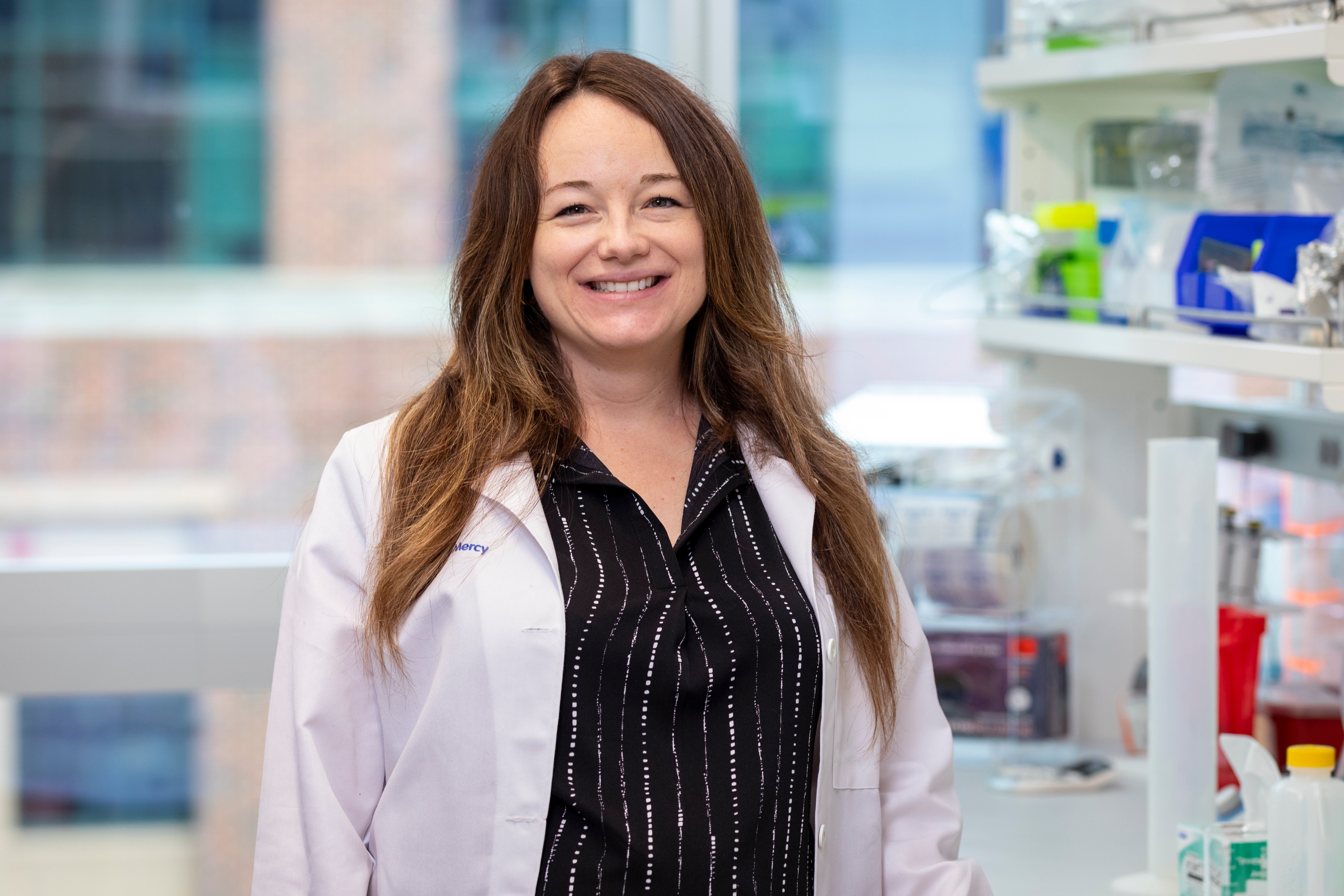
“I’m interested in better understanding why problems related to making blood cells develop — whether that’s too few in bone marrow failure or too many in cancer — so we can more precisely diagnose and treat patients with these hematologic diseases,” she said.
Leveraging mentorship and support into brighter futures
After eight years at Children’s Mercy, Dr. Prosser-Dombrowski still finds herself grateful and excited for the opportunity to bridge the gap between clinical care and research.
“The opportunity to be on both ends of the spectrum is incredible,” she said. “I get to be in both worlds and see that translational impact on patients and their care.”
That opportunity, she said, is due in large part to the mentorship she received since joining the organization.
“Without that, I would have never even known this is a path I could take,” she said. “I feel lucky in that I have people before me who are supportive of new ideas and will be there for me as I continue to develop my career.”
You can learn more about team members who are advancing the Children's Mercy pediatric footprint in the FY25 Research Annual Report.