
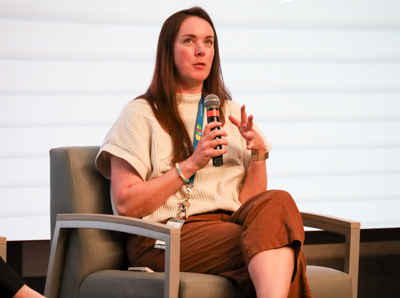
While Kathryn (Kate) Kyler, MD, MSc, FAAP, Hospital Medicine, Clinical Pharmacology, Toxicology and Therapeutic Innovation, has long been drawn to nutritional science, hospital medicine and pediatrics, her path into research began with the questions she couldn’t stop thinking about at the bedside.
Dr. Kyler first came to Children’s Mercy in 2016 as a Pediatric Hospital Medicine fellow before becoming a Pediatric Hospitalist. As she cared for children in the hospital, she began to wonder how obesity affected their care and recovery, especially when prescribing commonly used medications, such as those used during asthma exacerbations, without clear dosing guidance for children with obesity.
Those questions led her to pursue additional training in Pediatric Clinical Pharmacology from 2022 to 2024, giving her the research foundation to begin finding answers. Today, much of her work focuses on how obesity affects the way children with asthma process and respond to medications.
“Research has been a great way to exercise my brain in a different way from the clinical side of medicine,” she said. “I love both aspects of my career, and it’s been a fun way to spend my time doing a lot of different things, both clinically and academically.”
As both a Pediatric Hospitalist and Clinical Pharmacologist, Dr. Kyler sees the real-life impact behind her research. She sees the number of hospitalizations caused by asthma and how children with obesity have worse outcomes, poorer symptom control and a higher likelihood of experiencing asthma attacks with a difficult recovery period.
It’s impossible to do this alone. Leaning on your peers as well as your mentors is crucial to build community around you.
Steroids are one of the main treatments used to reduce inflammation during an asthma exacerbation. But for children with obesity, there are no clear dosing guidelines. Dr. Kyler hopes to help close that knowledge gap by answering an important question: Are these medications working the same way for every child?
NIH awards motivate long-term goals
Throughout her career, Dr. Kyler has received multiple internal and external grants to support her research. Among those awards were two National Institutes of Health (NIH) awards — a KL2 Mentored Career Development Award from the National Center for Advancing Translational Sciences through a Frontiers Clinical and Translational Science Institute subaward and a K23 grant from the National Heart, Lung, and Blood Institute. After the KL2 study ended, the work continued under the K23 grant with a deeper focus on the pharmacodynamics and pharmacokinetics in children with asthma and obesity.
Her long-term goal is to better understand how steroids affect children with obesity and use that data to help develop dosing recommendations specific to their needs. By closing this knowledge gap, Dr. Kyler hopes to help ensure children with obesity receive the right amount of medication to reduce inflammation, support recovery after an asthma attack and minimize potential side effects.
Building a community of scientists
How does this impact patient care at Children’s Mercy?
Research isn’t an overnight cure but instead it builds movement towards answering questions that are currently unclear. Dr. Kyler’s research is working towards a better future for children.
“It might be years down the line before my research is really going to impact patients, but I'm hopeful that I'll be able to improve the safety and efficacy of medications that we're prescribing to kids with obesity,” said Dr. Kyler.
Whether scientists are collaborating or simply confiding in their peers and mentors, research is a team effort. Dr. Kyler is a member of the Precision Therapeutics and Pediatric Obesity Research Group at Children’s Mercy Research Institute where investigators and clinicians who conduct research related to treatments for children with obesity share knowledge and form connections for future collaborations.
She stressed the importance of relying on your mentors and peers while building your research career.
“It’s impossible to do this alone,” she said. “Leaning on your peers as well as your mentors is crucial to build community around you. Being a clinician-researcher isn't the easiest career path to take, but it is definitely possible as long as you're able to surround yourself with a group of people, both peers and mentors, that are willing to support you.”
As Dr. Kyler’s mentors continue to help her through her research journey, she pays it forward by mentoring junior research faculty as they begin asking their own questions and building their careers.
You can learn more about team members who are advancing the Children's Mercy pediatric footprint in the FY26 Research Annual Report, which will be published soon.