
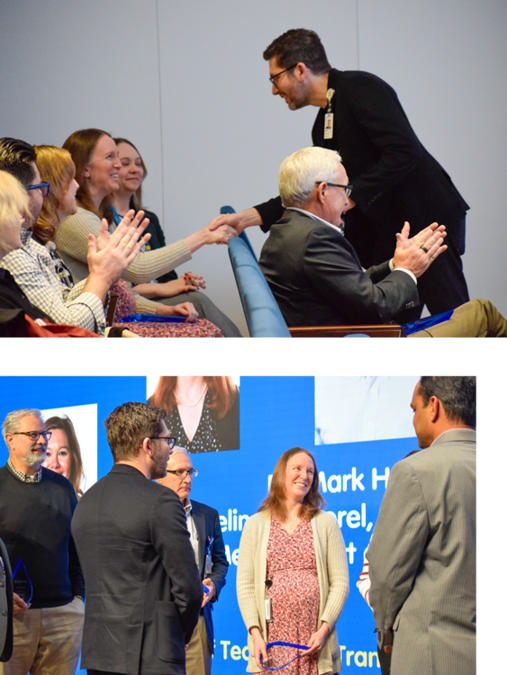
The Office of Technology Transfer and Commercialization (OTTC) at Children’s Mercy is a vital bridge between groundbreaking research and real-world applications. Led by Aswini Betha, PhD, CLP, Senior Director, OTTC, the team is committed to safeguarding and commercializing Children’s Mercy intellectual property (IP) to transform the ideas of clinicians, researchers and faculty into commercial products that improve pediatric care. IP refers to conceptual creations, like inventions or works of art. At Children’s Mercy, IP often includes medical devices, therapeutics, diagnostic tests, survey instruments, clinical webforms, educational materials and digital health apps. These creations can be legally protected through patents, copyrights and/or trademarks.
Dr. Betha, along with Senior Commercialization Managers Caronda Moore, PhD, and Christopher Hanson, JD, guide Children’s Mercy faculty through the complex processes of patenting and licensing technologies. While supporting academic freedom, the OTTC strives to ensure that promising discoveries are both protected and developed into therapeutics and products that make a meaningful impact on the lives of patients. The team also protects works of authorship and assists Children’s Mercy staff with copyright protection.
Commercialization success: Translating research into real-world solutions
In fiscal year (FY) 2025, the OTTC executed major licensing deals that highlight the potential of Children’s Mercy’s research. One agreement stemmed from a pharmacogenomic study led by Rose Gelineau-Morel, MD, Neurology, titled “Pharmacogenomic Contribution to the Biotransformation of Trihexyphenidyl and Development of a Precision Dosing Model for Children with Dystonia and Cerebral Palsy.” As Dr. Gelineau-Morel explains, one in 1,000 children are diagnosed with dystonia and cerebral palsy, a similar prevalence as Parkinson’s disease. Dystonia in cerebral palsy causes involuntary and painful muscle contractions, affecting a child’s ability to perform daily activities and worsening their quality of life.
With no FDA-approved medications, pediatric dystonia is treated with off-label medications that are often not effective and accompanied by additional side effects. One of the most common treatments is trihexyphenidyl (THP), a medication originally developed for Parkinson’s disease in adults. The treatment contains two mirror-image forms of the same chemical, designated as R-THP and S-THP. Dr. Gelineau-Morel’s study examines how an individual may metabolize these components differently. Her lab found that THP is metabolized by two enzymes, CYP2D6 and CYP2C19; R-THP is primarily metabolized by CYP2C19 and S-THP is metabolized by CYP2D6. Depending on a person’s genotype, these enzymes may function very rapidly or not function at all, potentially leading to higher or lower levels of R-THP and S-THP in each person. Furthermore, R-THP appears to be more effective than S-THP for treating dystonia with fewer side effects. Therefore, Dr. Gelineau-Morel’s team proposes isolating R-THP from the racemic mixture and adjusting the dosage of R-THP based on the CYP2C19 genotype for each patient.
The OTTC team filed patent applications to protect Dr. Gelineau-Morel’s technology, which will support development of a more targeted and effective therapy for movement disorders with fewer side effects, tailored to individual genetic profiles. To achieve that goal, Children’s Mercy licensed the technology to Vima Therapeutics, a clinical stage pharma company. Patent applications are currently pending in 14 countries.
Building a culture of innovation and commercialization
The OTTC supports any Children’s Mercy employee with an idea that has significant IP strength and commercial potential. This includes inventions made in a traditional laboratory setting and employee innovations from a wide variety of departments throughout the hospital.
The commercialization journey begins with identifying IP early. Dr. Betha emphasizes the importance of engaging with the OTTC before publishing or presenting new ideas, which can jeopardize patent rights. Early involvement allows the team to conduct a thorough prior art search to assess patentability and plan an IP protection strategy. This enables the researcher to have open communication with the scientific community as the work matures.
Once an invention is deemed viable, Dr. Betha’s team works with patent attorneys to draft and file patent applications. Patenting is a lengthy process, but urgency is sometimes necessary. Within weeks of submitting an invention disclosure, the OTTC team coordinated the preparation and filing of a provisional patent application protecting Dr. Gelineau-Morel’s invention. “Working with the tech transfer office allows you to advance innovations more quickly and actually develop them so that people can benefit from your ideas,” said Dr. Gelineau-Morel.
When IP protections are in place, the OTTC team initiates targeted marketing campaigns to potential industry partners for commercialization of Children’s Mercy innovations. Once a company shows interest, the team negotiates a licensing agreement that generates revenue for the inventors and supports future Children’s Mercy research and education.
Working with the tech transfer office allows you to advance innovations more quickly and actually develop them so that people can benefit from your ideas.
Under Children’s Mercy’s IP policy, inventors receive 30% of the net revenues from commercialization. The rest of the revenue is divided between the inventor’s respective department, which receives 25%, with favorable consideration for the innovator’s labs and programs, and Children’s Mercy as a whole, which receives 45% to support research and education.
Expanding impact and presence
The team is actively working to inform Children’s Mercy faculty about IP protection and the licensing process. In FY25, Dr. Betha’s team adopted the Intellectual Property Mining (IP Mining) program to better connect with researchers, clinicians and faculty. Through this program, the team proactively meets with Children’s Mercy researchers and staff to help them identify and protect potential IP assets. In FY25, the team met with over 175 Children’s Mercy professionals to foster a culture of innovation across departments.
“The tech transfer office is a platform to translate Children’s Mercy’s intellectual property into real-world solutions,” said Dr. Betha. “Our top priority is always inventors.”
Besides the licensing deals and implementing IP Mining, the tech transfer team has accomplished many goals in FY25, including the following:
- Triaged and docketed 19 invention disclosures.
- Filed 21 patent applications.
- Executed over a dozen non-disclosure agreements.
- Assisted with numerous agreements by providing guidance on IP and licensing terms.
- Hosted Children’s Mercy’s first National Inventors’ Day event.
- Delivered 15 technology transfer presentations across various departments and divisions.
The tech transfer office is a platform to translate Children’s Mercy’s intellectual property into real-world solutions. Our top priority is always inventors.
The team also plays a key role in the Mercy Research Partners program, which brings together donors and researchers to fund promising pediatric innovations. For the first time, the program included external scientific reviews, adding objectivity and credibility to the evaluation process.
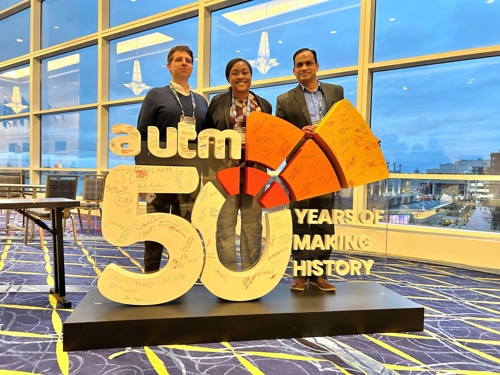
The tech transfer team is committed to bringing industry standards of excellence to Children’s Mercy. Dr. Betha’s team are members of AUTM, a non-profit association that supports academic research through the advancement of technology transfer. The team utilizes AUTM’s educational opportunities, industry surveys and other professional development tools to bring AUTM’s best practices to Children’s Mercy tech transfer.
The future of tech transfer
While the OTTC is focusing on IP assets and educating Children’s Mercy employees, they have big plans for the future. In 2026, Dr. Betha’s team plans to launch Tech Transfer 2.0 — a strategic initiative aimed at increasing participation in Small Business Innovation Research and Small Business Technology Transfer (SBIR/STTR) grants. These federal grants support small start-ups and businesses developing high-impact technologies to encourage innovation.
Dr. Betha envisions Children’s Mercy’s OTTC playing a central role in Kansas City’s thriving entrepreneurial and commercialization ecosystem. This includes hospitals, universities and non-profit organizations. By collaborating with these institutions, Children’s Mercy could amplify its research impact and create new opportunities for innovation.
You can read more about our translational research efforts to improve the health and wellbeing of children and so much more in the FY25 Research Annual Report.