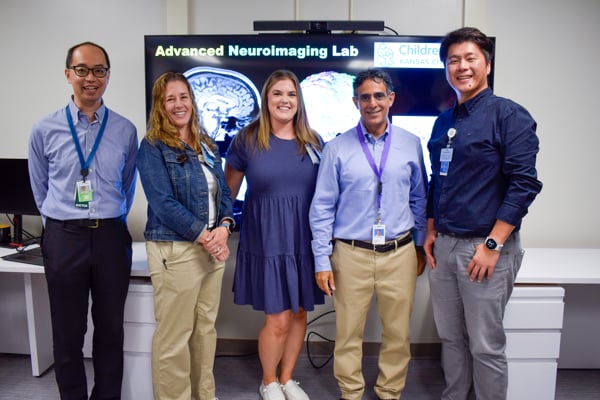
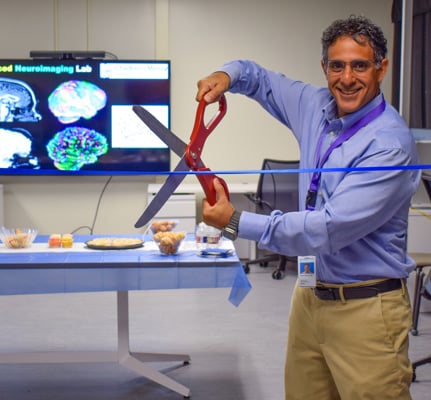
After about a year in the making, the Advanced Neuroimaging Lab officially opened on Wednesday, Aug. 14, 2024, at Children’s Mercy Research Institute (CMRI). The Advanced Neuroimaging Lab is designed to use state-of-the-art neuroimaging techniques, technologies and hardware to examine the pediatric human brain. Bench-to-bedside research is the overall goal of the lab, as scientists use new technologies to help diagnose and treat pediatric patients.
“The lab's mission is to bridge the gap between the research and the clinical care and making advanced neuroimaging tools practical and impactful for each individual patient,” said Avner Meoded, MD, the head of the Advanced Neuroimaging Lab.
The lab focuses on various studies involving the brains of pediatric patients. In fiscal year 25, a total of nine studies used technologies in the Advanced Neuroimaging Lab.
Creating the Advanced Neuroimaging Lab
Before Dr. Meoded’s first day in 2023, he initiated the process to build the Advanced Neuroimaging Lab with CMRI in hopes of continuing his journey in pediatric imaging research in his new role at Children’s Mercy. The creation of this lab was successful thanks to several Children’s Mercy faculty:
- Radiology leadership team: Douglas Rivard, DO, Executive Vice President & Physician-in-Chief; Sherwin Chan, MD, PhD, Vice Chair, Radiology Research; Kristin Leland, MD, Chair, Radiology, Medical Director, Fetal MRI, Associate Program Director, Pediatric Radiology Fellowship; Alison Bender, MHSA, Department Administrator, Radiology (Imaging Services), Medical Administration, Pathology and Laboratory Medicine; and Jennifer Lopez, Division Administrator, Radiology (Imaging Services).
- Radiology research team: HyukJin Yun, PhD, Research Scientist, Radiology (Imaging Services); Amber Bagherian, MS, CCRC, Clinical Research Team Manager, Children’s Mercy Research Institute; Maura Sien, MSML, RT(R), CCRC, Senior Clinical Research Coordinator, Radiology (Imaging Services); Sarah Foster, BS, RT(R), Clinical Research Coordinator I; Nathan Artz, PhD, MS, MEd, DABR, Medical Physicist, Radiology (Imaging Services); and Amit Jain, PhD, Medical Physicist, Radiology (Imaging Services).
- Research informatics & data science team: Matthew Breitkreutz, Director, Research Informatics Innovation and Experience, Research Informatics and Data Science; Christian Masters, Sr. Spec, Research Business Systems, Research Informatics and Data Science; Bourke Hutchinson, Sr. Manager, Research Compute & Infrastructure Engineering, Research Informatics and Data Science; Kevin Power, Director, Research Informatics Engineering, Research Informatics and Data Science; and Lisa Sanesanong, MEd, PMP, Sr. Project Manager, Research Informatics, Research Informatics and Data Science.
- Research development team: Sarah Schlachter, MEd, PMP, Director, Research Development, Research and Sponsored Projects Administration; and Daniel Heruth, PhD, Sr. Director, CMRI Laboratory Operations, Research and Sponsored Projects Administration.
- Facilities team: Jason Mychalczuk, Project Manager, Facilities Construction, Facility Planning; and Kevin Dizney, Facility Project Coordinator, Facility Planning.
With all the resources in the lab, we will translate the science into real-world solutions that help kids with neurological disease.
Currently, the team members of the Advanced Neuroimaging Lab include Dr. Meoded and Dr. Yun. Additionally, the lab employs three research coordinators who assist with day-to-day research operations and coordinate data collection and analysis.
Outside of Dr. Meoded and Dr. Yun’s offices, the lab is home to four workstations where researchers can retrieve patient files and images and conduct research and image analysis. A powerful virtual Linux workstation is available as a remote desktop that allows researchers to render images and complete visualization to analyze work. The lab is starting to integrate machine learning and artificial intelligence to improve diagnostic capabilities and the ability to predict the outcome of a particular diagnosis for affected children.
Each brain scan of a pediatric patient generates a huge data file. To conduct cutting-edge research, many patient brain scans are analyzed, which requires high performance computing power to generate answers that advance care for pediatric patients. The Advanced Research Computing (ARC) team within Research Informatics & Data Science assists the laboratory by providing high performance computer clusters (HPCs). These are shared servers, with open access to all CMRI researchers, that help run computations to analyze data.
Open for collaboration
The Advanced Neuroimaging Lab collaborates internally with Neurology faculty to assist with ongoing studies. Rose Gelineau-Morel, MD, Neurology, is utilizing these technological advancements with her study on cerebral palsy. Endocrinology is also working with the lab for a Turner syndrome study.
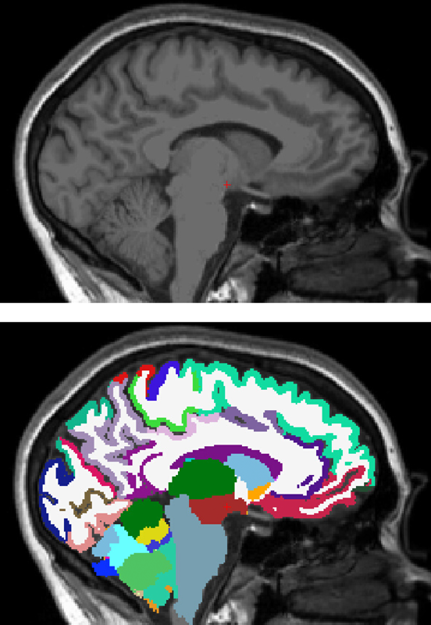
The lab team uses several non-invasive neuroimaging techniques — diffusion weighted imaging (DWI), diffusion tensor imaging (DTI), surface based analysis and resting state functional connectivity — to track neural pathways in the brain. The images can then undergo fiber tractography, creating a three-dimensional rendering of the brain that highlights the neural pathways. Since fiber tractography does not allow researchers to see which areas are connected in the patient’s brain, a parcellated anatomical image is used to visualize the brain’s connectivity. It creates a brain image that has been divided into distinct regions sharing a common border based on anatomical features. The overall process creates a patient connectome — a comprehensive network representing the neural connections comprised of the human brain. The lab is using HPCs to develop a processing pipeline for connectome reconstruction of healthy children and patients with neurologic disorders to be available for Children’s Mercy researchers and clinicians.
External researchers benefit from neuroimaging lab
The lab team is collaborating with outside institutions on several studies. Dr. Meoded is the co-principal investigator alongside researchers at the Baylor College of Medicine for “A Systems Epidemiology Approach for Predicting Methotrexate Neurotoxicity in Pediatric Acute Leukemia.” This study analyzes white matter in the brain of children with leukemia who may experience neurotoxicity from the chemotherapy and immunosuppressive drug methotrexate.
The MD Anderson Cancer Center collaborates with Dr. Meoded on their study, “A Comprehensive Clinical fMRI Software Solution to Enable Mapping of Critical Functional Networks and Cerebrovascular Reactivity in the Brain.” Children’s Mercy is responsible for validating this software in children with epilepsy who are undergoing surgery.
NMR in Biomedicine featured a study Dr. Meoded co-authored with scientists at Michigan State University. The study, “Volumetric and Diffusion Tensor Imaging Abnormalities Are Associated With Behavioral Changes Post-Concussion in a Youth Pig Model of Mild Traumatic Brain Injury,” looked at young pig brains with mild traumatic brain injuries. The study, Dr. Meoded explains, can be translated to real-life pediatric cases of concussions or other traumatic brain injuries.
Lab members are also collaborating with The Johns Hopkins University School of Medicine on pediatric strokes.
Spreading the word
Dr. Meoded’s team has spread the word about the modern technologies and techniques being used at CMRI. In May 2025, Dr. Yun presented at the Society of Informatics in Medicine — an organization promoting the improvement in imaging and artificial intelligence services. The presentation — A Robust and Reliable Processing Pipeline on the Cluster for Quantitative Pediatric Neuroimaging — highlighted the Advanced Neuroimaging Lab’s usage of HPCs creating a neuroimaging processing pipeline and the successful resource it could become in clinical settings.
Big plans for imaging services
While the lab is relatively new, the team continues to push for growth. CMRI leadership has approved the Radiology research team’s request to establish an imaging core at Children’s Mercy. Dr. Meoded plans for this to be a multi-disciplinary hub where radiology is connected to all hospital departments to provide advanced imaging services. The goal is to implement a state-of-the-art imaging core that will help address the high demand for neuro and non-neuro imaging research and to bring Children’s Mercy to the forefront of imaging technological innovation.